
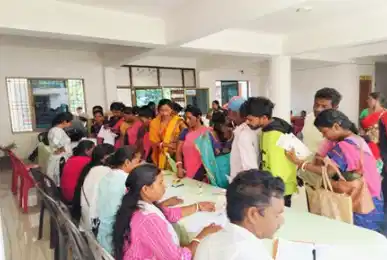
Noamundi Achieves 100% Disability Coverage Under Government Schemes

Noamundi Achieves 100% Disability Coverage Under Government Schemes

Jharkhand Block Becomes First to Identify and Certify All Eligible Persons with Disabilities
Key Points:
- Noamundi becomes first Jharkhand block with 100% disability identification
- 292 persons with disabilities connected to sustainable livelihood opportunities
- Tata Steel Foundation’s Sabal initiative drives systematic inclusion model
NOAMUNDI – Noamundi has become Jharkhand’s first administrative block to achieve complete disability coverage. Every eligible person with disability has been identified and certified.
The mining town has linked all disabled persons to government schemes. This marks a significant milestone for the state. Moreover, the transformation came through focused efforts and patience.
Tata Steel Foundation’s flagship disability inclusion initiative Sabal drives this change. The program started in 2017 with a rights-based approach. It has now evolved into a systematic transformation model.
Rural India sees three out of four disabled persons remain invisible. They stay unregistered and unsupported by formal systems. Noamundi faced similar challenges earlier.
Only a small proportion accessed disability certificates previously. Pension benefits and assistive devices remained out of reach. However, this changed through systematic intervention.
Sabal’s ICAS model set an unprecedented goal of complete saturation. The Rights of Persons with Disabilities Act 2016 anchors this approach. Meanwhile, the strategy strengthened rural service delivery foundations.
A total of 135 anganwadi workers received specialized training. They learned to identify all 21 types of disabilities. In addition, digital tools enabled accurate data capture.
The Sabal digital app captured real-time disability profiles systematically. Panchayats and government departments became co-owners of this process. Furthermore, local influencers actively participated in the initiative.
This collaborative approach ensured active participation from disabled persons. They became partners in their inclusion journey. Within months, Noamundi achieved 100% identification rate.
Beyond entitlements, the program focused on enabling independence. A total of 292 persons with disabilities gained livelihood connections. These include skill development and enterprise support opportunities.
Assistive technologies played a decisive role in empowerment. The Jyotirgamaya initiative developed with IIT Delhi’s Assistech Lab helped. Visually impaired persons gained abilities to read and write independently.
They can now manage bank accounts and navigate digital spaces. On the other hand, employment linkages provide sustainable income sources. The program demonstrates that inclusion requires systematic design.
Building frontline capacities proved crucial for success. Integrating digital tools transformed the fragmented system into responsive one. Besides, community ownership ensured program sustainability.
Today, Noamundi serves as a national blueprint for rural disability inclusion. The model is expanding to districts across Jharkhand and Odisha. However, each new geography brings its unique challenges.
The initiative proves that dignity-centered development yields remarkable results. Inclusion begins with being counted and recognized. Noamundi demonstrates that complete inclusion is achievable.
The program converted invisibility into visibility through systematic efforts. Rights became reality for every eligible disabled person. Moreover, the sustainable model offers replicable solutions statewide.


Join Our Newsletter
Related News
Opinion
You May Also Like
Read More
Discussion
Readers' Comments
Recent
EDITOR PICKS
POPULAR POSTS
MUST READ

ABOUT US
Town Post is a leading News Portal of Jamshedpur and Jharkhand.
FOLLOW US
Contact us: editor@townpost.net
© Town Post, Jamshedpur