
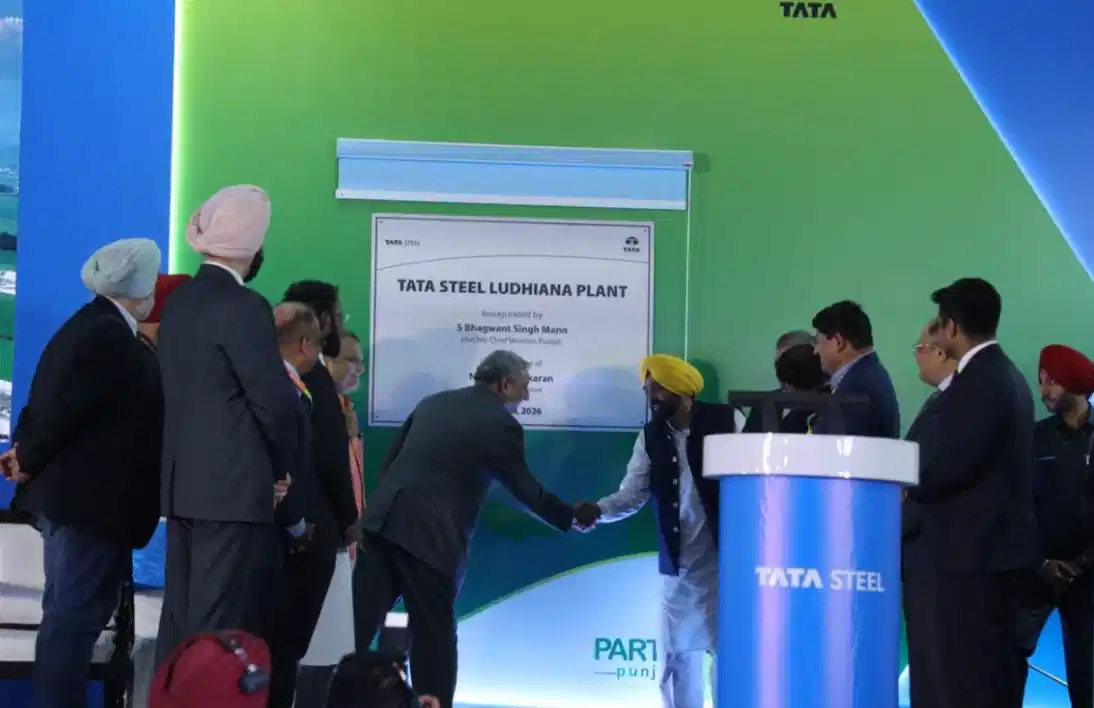
Tata Steel Launches India's First Scrap-Based Electric Arc Furnace in Ludhiana

Tata Steel Launches India’s First Scrap-Based Electric Arc Furnace in Ludhiana

₹3,200-Crore Plant in Punjab to Cut CO₂ Emissions Below 0.3 Tonne Per Tonne of Steel
Key Points:
- Tata Steel’s EAF in Ludhiana has 0.75 million tonne annual capacity
- Plant uses 100% steel scrap; targets Net Zero emissions by 2045
- Punjab CM Bhagwant Singh Mann and Tata Steel Chairman N Chandrasekaran inaugurate facility
JAMSHEDPUR – Tata Steel on Thursday inaugurated India’s first scrap-based Electric Arc Furnace at Hi-Tech Valley, Ludhiana, marking a significant moment in the company’s push toward low-carbon steelmaking.
The facility has been built with an investment of approximately ₹3,200 crore. Moreover, it carries an annual production capacity of 0.75 million tonnes of steel.
Punjab Chief Minister Bhagwant Singh Mann graced the ceremony alongside Tata Steel Chairman N Chandrasekaran. In addition, CEO and Managing Director T V Narendran and senior government and company officials were present at the inauguration.
Chandrasekaran described the green steelmaking push as a national imperative. “Tata Steel’s Ludhiana Electric Arc Furnace reflects Tata Group’s long-term commitment to building a greener, more resilient industrial future,” he said.
Narendran called the Ludhiana plant a milestone in Tata Steel’s Net Zero journey. He said the facility demonstrates how capital investment can support circular economy goals. He also thanked the Punjab government for its support.
The plant has been designed to achieve CO₂ emissions of less than 0.3 tonnes per tonne of steel produced. It is a key element in Tata Steel’s target of reaching Net Zero emissions by 2045.
The facility will run on nearly 50% renewable energy. On the other hand, it will use 100% steel scrap as its sole raw material — a sharp departure from conventional blast furnace-based steelmaking.
Around 40% of the scrap input will be sourced from the company’s steel recycling plant in Rohtak, Haryana. The remaining scrap will be procured from other sources.
The plant will produce construction-grade steel rebar under Tata Steel’s retail brand Tata Tiscon. This output will strengthen the company’s footprint in India’s construction materials market.
Over the past three years, Tata Steel Foundation has been engaged with communities near the Ludhiana plant. The foundation’s work has spanned health, education, agriculture, and women’s empowerment.
Key community initiatives include employability training at local Industrial Training Institutes. In addition, the foundation has introduced new livelihood options for women, installed solar-powered streetlights, and promoted climate-resilient farming.
Other efforts have included building community waste management systems, embedding ecology into school infrastructure, and extending scholarships to deserving students.


Join Our Newsletter
Related News
Opinion
You May Also Like
Read More
Discussion
Readers' Comments
Recent
EDITOR PICKS
POPULAR POSTS
MUST READ

ABOUT US
Town Post is a leading News Portal of Jamshedpur and Jharkhand.
FOLLOW US
Contact us: editor@townpost.net
© Town Post, Jamshedpur