
Woman's Body Carried 11 km by Villagers Due to Lack of Road in West Singhbhum

Woman’s Body Carried 11 km by Villagers Due to Lack of Road in West Singhbhum

Villagers forced to carry deceased woman’s body 11 km on foot due to absence of road, sparking anger in West Singhbhum.
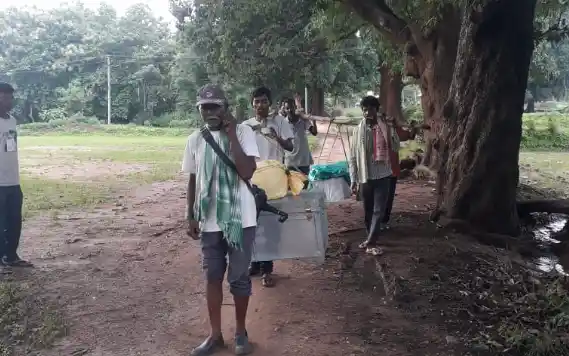
In a tragic incident that highlights the dire lack of infrastructure in West Singhbhum, villagers had to carry the body of a 22-year-old woman, Silvanti Nag, on foot for 11 kilometers due to the absence of a motorable road.
CHAIBASA – In a tragic incident that highlights the dire lack of infrastructure in West Singhbhum, villagers had to carry the body of a 22-year-old woman, Silvanti Nag, on foot for 11 kilometers due to the absence of a motorable road.
Silvanti, a resident of Tujur village in Gudri block, passed away from malaria at RIMS in Ranchi on Thursday.
After transporting her body by vehicle to Koleda, villagers were forced to carry the coffin on foot for the remaining 11 kilometers to Tujur village using a makeshift stretcher.
Basu Borjo, a resident of Podenger, shared that Silvanti was the wife of Anoop Nag, and they had been married for only two years.
He expressed frustration over the lack of proper medical facilities and the absence of a road, which forced the villagers to carry the body on foot.
The villagers have long demanded the construction of a road in the area, but their pleas have gone unanswered.
Borjo also mentioned that a meeting was held recently regarding road construction, attended by Jagat Manjhi, the son of MP Joba Manjhi.
Despite assurances that a 35-kilometer road from Podenger to Gudri would be built, no progress has been made.
The lack of infrastructure has caused significant hardship for the residents, especially in emergencies.
Villagers have also called for the construction of a hospital in Bandgaon to provide much-needed healthcare services.
Currently, residents must travel to Ranchi for medical treatment, which is often delayed due to the poor road conditions, leading to numerous deaths.
The local community urges the government to address these issues by building roads that connect remote villages to the main roads and by improving healthcare facilities.


Join Our Newsletter
Related News
Opinion
You May Also Like
Read More
Discussion
Readers' Comments
Recent
EDITOR PICKS
POPULAR POSTS
MUST READ

ABOUT US
Town Post is a leading News Portal of Jamshedpur and Jharkhand.
FOLLOW US
Contact us: editor@townpost.net
© Town Post, Jamshedpur