
How Tata Steel Is Leading Sustainability in the Steel Sector

How Tata Steel Is Leading Sustainability in the Steel Sector

Tata Steel’s sustainability initiatives set new benchmarks in the steel industry, aiming for Net Zero emissions by 2045 and promoting environmental responsibility.
Tata Steel, a global leader in the steel industry, is committed to achieving Net Zero emissions by 2045, aligning with the Tata Group’s Project Aalingana. The company has implemented various initiatives to reduce its carbon footprint, conserve water, manage waste, and protect biodiversity.
JAMSHEDPUR – Steel sector today, both globally and in India is being closely watched by sustainability advocates for its role in building an environmentally responsible ecosystem that not only continues to produce the world’s favourite alloy but one that does not leave behind any unwanted residue that could pollute the air, water, or earth.
As an energy and other resources intensive sector, the sustainability challenge faced by the steel sector is no ordinary one and demands a fundamental shift in how it has been operating for decades now. It is in this context that Tata Steel, India’s oldest steel maker and one with a global footprint is fast emerging as a leader in sustainability too.
As a responsible and trusted corporate citizen with a brand name that is recognised and respected within and beyond India’s border, Tata Steel has for the last more than a decade successfully embarked on a remarkable sustainability journey that is setting new benchmarks on a wide range of environmental parameters not only for its own operations but also for others to emulate too.
In an effort to minimise its carbon footprint and pivot towards sustainable practices, Tata Steel is committed to the Tata Group’s stated objective of achieving Net Zero emissions by 2045 as part of the group-wide Project Aalingana.
As we celebrate the Sustainability Month (in June every year) flagged by the World Environment Day (on June 5) let us look at the some of the key initiatives and achievements of Tata Steel in these two vital and interconnected challenges.
Water
Water is one of the critical resources for producing steel. Over the last 5 years, Tata Steel has reduced the specific freshwater consumption (m3/tcs) for its crude steel manufacturing sites in the country by 33%.
It has managed to do this by implementing various water conservation projects at its steelmaking and mining sites. These include deploying dry processes for reduction, pumping infrastructure for water recovery, and a central effluent treatment plant with reverse osmosis to treat and recycle effluent in steelmaking processes. The treated effluents are being reused for low-end applications like coke quenching, blast furnace slag granulation, steel slag quenching, sinter and pellet mixing, gas cleaning plant, horticulture, dust suppression, etc.
Air
Reduction of dust emission is one of the thrust areas to improve air quality across Tata Steel’s operating sites. This has been achieved through upgraded pollution control equipment, implementation of new technologies, consistent internal efforts and maintenance strategies. These measures have helped Tata Steel to significantly reduce its stack dust emissions in the country.
From 1994-95 to 2023-24, stack dust emissions were reduced by 97.8% and 67% at the Jamshedpur and Kalinganagar steelworks respectively. Similarly, since its acquisition in 2018-19, the Meramandali plant’s (India’s largest flat steel production plant) stack dust emissions have also been reduced by 54% by 61% at Gamharia (Tata Steel Long Products).
Committed to its ‘Zero Waste to Landfill’ target, Tata Steel handles around 16 million tonnes of by-products per annum (MTPA), spanning 25+ product categories with 250+ stock keeping units or SKUs. As a one of its kind in the industry , a dedicated Industrial By-Products Management Division handles the by-products generated in the value chain of the steel making process.
Most of the by-products generated form a key raw materials source for various industries like cement, chemicals, construction, railways and power. In FY 2023-24, Tata Steel achieved 100% solid waste utilization at Jamshedpur, Kalinganagar, Meramandali, and Gamharia. Steel making (LD) slag , a by-product during steel making process, has been a challenge for the entire steel industry owing to its properties and limited applicates and traditionally had been posing an environmental challenge as it would largely go into landfills, in the past.
Tata Steel became the first plant in India to implement the in-house developed technology of accelerated weathering (steam aging facility) of steel slag on an industrial scale. This has enabled manufacturing of superior quality aggregates which are used as replacement of natural aggregates in road construction.
In a first of its kind initiative in the country, Tata Steel launched two new products – Tata Aggreto and Tata Nirman, for application in road, fly ash brick and cement manufacturing. Apart from extensive utilization in National Highways, State Highways, city roads and rural roads (under Pradhan Mantri Gram Sadak Yojana, PMGSY), these products have been successfully used to construct over 1 kilometer stretch of road connecting the Sino-Indian border in Arunachal Pradesh by Border Roads Organisation (BRO).
Tata Aggreto and Tata Nirman has been tested to be a superior product over natural aggregates in road construction industry helping in conservation of natural biodiversity. Tata Steel has also developed a patented sustainable waste management technology for utilizing Basic Oxygen Furnace slag to manufacture a sulfur-rich nutrient supplement branded ‘Dhruvi Gold’.
Blast Furnace slag is another voluminous solid waste or by-product generated from integrated steel plants. Based on this material, Tata Steel has introduced a new brand – Tata Dureco, which is Ground Granulated Blast Furnace Slag (GGBS). It is a GreenPro certified sustainable product which can be used as partial replacement of cement in concrete production and is extensively used in the construction industry.
Tata Dureco has been used in developing some of the iconic nation building projects in the country and has gathered interest for may key projects both in domestic as well as international markets. Other key initiatives include a one-of-a-kind endeavor to convert the hazardous sludge of steel plant into value-added pellets, replacement of coal tar usage in blast furnace by low-sulfur furnace oil which is a greener alternative. Tata Steel has also developed eco-friendly light construction products such as green paver blocks and interlocking blocks, which are manufactured using iron and steel slags.
Cutting Carbon footprint
As part of its efforts to reduce carbon footprint from its manufacturing processes, Tata Steel has adopted the ‘circular economy’ route, a key element of which is recycling of steel scrap. The company is implementing innovative strategies to enhance steel scrap utilisation in steelmaking, including establishing an Electric Arc Furnace (EAF) based long products steel plant in Ludhiana. This plant will have a minimal carbon footprint and a capacity of 0.75 MnTPA, maximising the use of steel scrap.
Clean energy transition
India is currently undergoing one of the world’s largest clean energy transitions that is impacting every industrial sector. Given that steel making is an energy-intensive sector, Tata Steel too is increasing its clean energy portfolio by partnering with Tata Power Renewable Energy Ltd to establish approximately ~966 MW of solar and wind hybrid renewable power capacity under a captive arrangement. This initiative will address 379 MW of the Company’s power requirement in India and facilitate an annual reduction of over 2 million tonnes of CO2 emissions.
Biodiversity Conservation
Tata Steel has persistently made efforts to improve its performance in biodiversity conservation and reduce its impact on the ecosystem. It endeavors to avoid, minimize, regenerate, restore and transform its biodiversity impact. The Company’s operations are not located in any of the identified biodiversity hotspots or protected areas. In consultation with stakeholders and experts, the Company has developed Biodiversity Management Plans (BMPs) for 17 sites and plans to cover the remaining ones.
In Jharia, Tata Steel has championed bamboo plantation in the leasehold and barren community land, aggregating to about 110 acres. A strong collaboration with farmers in the plantation areas generates new livelihood opportunities, reducing their vulnerability to climate change.
In Gamharia, a 30-acre barren ash mound within the plant premises was stabilized by developing a rich biodiversity park, Kailash Top, with around 25,000 plants and shrubs.
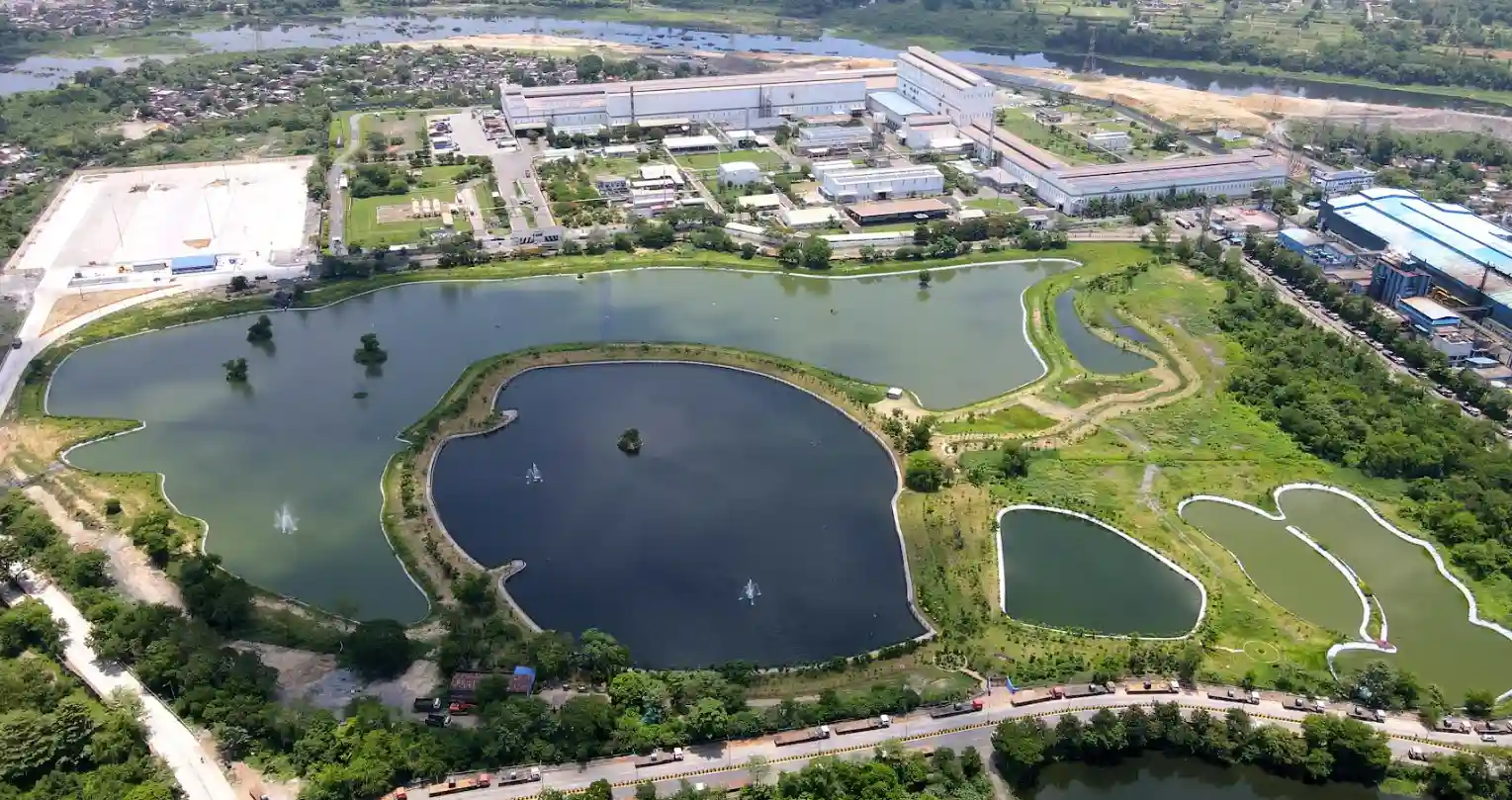
The water requirement is managed through treated wastewater from the captive effluent treatment plant, realising the principle of circularity. In Jamshedpur, Tata Steel has created a new 1-acre water body in the Sidhgora area, with a capacity of 10 million litres. In Meramandali, a 9.5-acre pond was renovated. With a 25 million litres capacity, the water body touches the lives of 600 people.
In recent past, nature trails, biodiversity parks and urban forests have been set up in Kadma, CH area, Sonari, Sidhgora among other places of Jamshedpur besides rejuvenation of water bodies in CRM Bara and other strategically important locations of Jamshedpur.
Recognitions
Tata Steel’s efforts have been receiving global recognition in some of the most important sustainability forums. The company has been recognised as a Steel Sustainability Champion 2024 by worldsteel for the seventh consecutive year for its commitment and action to sustainable development and adherence to world-class standards.
Earlier this year, the company’s plants in Kalinganagar and Meramandali received ResponsibleSteelTM Certification, while the same status was conferred on its Jamshedpur plant in 2022, making it the first one in India to receive this prestigious status.


Join Our Newsletter
Related News
Opinion
You May Also Like
Read More
Discussion
Readers' Comments
Recent
EDITOR PICKS
POPULAR POSTS
MUST READ

ABOUT US
Town Post is a leading News Portal of Jamshedpur and Jharkhand.
FOLLOW US
Contact us: editor@townpost.net
© Town Post, Jamshedpur