
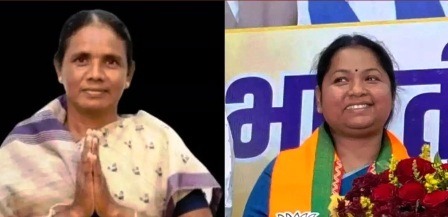
Singhbhum Poised for Historic Showdown as Geeta Koda and Joba Majhi Vie for Victory

Singhbhum Poised for Historic Showdown as Geeta Koda and Joba Majhi Vie for Victory

Geeta Koda and Joba Manjhi Bring Contrasting Strategies and Alliances to the Electoral Battleground
The Singhbhum Lok Sabha constituency in Kolhan is gearing up for an unprecedented electoral contest as two prominent women candidates, Geeta Koda and Joba Manjhi, go head-to-head for the first time in the region’s political history.
CHAIBASA – In a historic first for the Singhbhum Lok Sabha seat, incumbent MP Geeta Koda of the NDA coalition faces off against Joba Manjhi, an MLA from Manoharpur nominated by the JMM and backed by the INDIA bloc.
The electoral battle promises to be a captivating showcase of contrasting campaign strategies and alliances.
Geeta Koda, riding on the development agenda championed by Prime Minister Narendra Modi, anchors her campaign on the promises of progress and prosperity for the constituency.
On the other hand, Joba Manjhi capitalizes on the tribal unrest following the arrest of former Chief Minister Hemant Soren, framing it as a rallying point for tribal empowerment.
The complex tribal dynamics of the region add an intriguing layer to the electoral landscape, with the Ho community constituting a significant 59 percent of the tribal population.
While this demographic gives Geeta Koda a strategic advantage, Joba Manjhi, a member of the Santhal community, aims to bridge the gap by galvanizing tribal sentiments.
The Koda family’s long-standing political influence in Kolhan, reinforced by successive electoral victories since 2000, underscores Geeta Koda’s formidable position.
Her transition from a Congress ticket in the 2019 Lok Sabha polls to the BJP banner reflects her confidence in securing a second term.
However, the divergent electoral preferences within tribal communities, particularly between the Ho and Santhal, highlight the potential for a fractured tribal vote.
Local voices underscore the pivotal role of caste affiliations in determining electoral outcomes.
The JMM’s resolute support for Joba Manjhi’s candidacy, despite reservations among some voters, reveals the intricate interplay of party strategies and tribal aspirations.
The electoral narrative oscillates between development imperatives and tribal solidarity, adding multiple dimensions to the contest.
With a diverse field of 14 candidates, including five from the Ho community, the electoral landscape is marked by dynamism and the specter of caste polarization.
Gabbar Singh Hembrom, General Secretary of the Adivasi Ho Mahasabha, emphasizes the fluidity of electoral dynamics amidst tribal discontent over Hemant Soren’s arrest.
Despite high-profile visits by BJP leaders, including Modi and Shah, the contest remains unpredictable, underlining the enduring significance of local factors.
As Singhbhum prepares for the polls on Monday, with voting scheduled from 7 am to 5 pm, the convergence of gender, caste, and tribal identities is set to reshape the contours of political representation in Jharkhand.
The historic showdown between two women candidates marks a defining moment in the state’s democratic journey.


Join Our Newsletter
Related News
Opinion
Read More
Discussion
Readers' Comments
Recent
EDITOR PICKS
POPULAR POSTS
MUST READ

ABOUT US
Town Post is a leading News Portal of Jamshedpur and Jharkhand.
FOLLOW US
Contact us: editor@townpost.net
© Town Post, Jamshedpur