
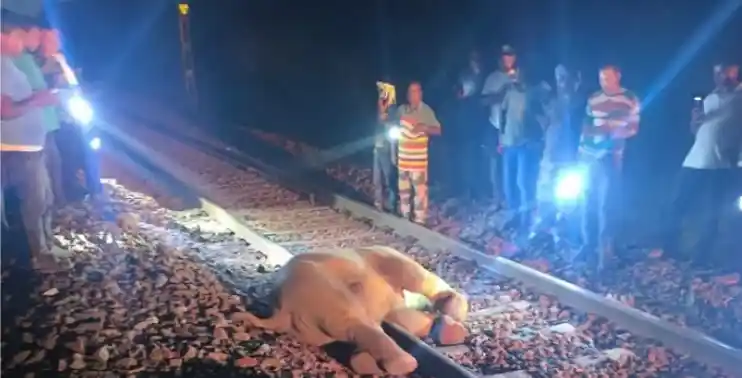
Elephant Calf Killed in Train Collision Near Bandamunda

Elephant Calf Killed in Train Collision Near Bandamunda

Incident sparks protests as forest officials detain assistant driver
Key Points:
• 8-month-old elephant calf struck by freight train in Chakradharpur division
• Forest department questions assistant driver, prompting crew protests
• Authorities investigating train speed and circumstances of the accident
JAMSHEDPUR – A tragic accident involving a freight train and an elephant calf has raised concerns about wildlife safety in the Chakradharpur Railway Division.
An eight-month-old elephant calf lost its life in a collision with a freight train.
The incident occurred near Bandamunda, within the Chakradharpur Railway Division.
Following the accident, forest officials detained assistant driver Kaviraj Mahato for questioning.
This action sparked protests from train drivers at the Bandamunda crew lobby.
The drivers demanded the immediate release of their colleague.
Meanwhile, Rourkela DFO Yashwant Sethi provided insights into the incident.
Sethi revealed that a herd of elephants had been in the area for three days prior.
Notably, the forest department had informed railway authorities about the elephants’ presence.
However, it appears no significant preventive measures were taken.
The tragic collision occurred around 9:30 PM as the herd crossed the railway track.
The calf died upon impact with the freight train.
Authorities are now investigating the train’s speed at the time of the accident.
They are also examining other circumstances surrounding the incident.
A wildlife expert commented, "This highlights the need for better wildlife corridor management."
The accident has reignited discussions about the coexistence of railways and wildlife.
Local environmental groups are calling for enhanced safety measures in known elephant habitats.
Railway officials face pressure to implement more effective warning systems.
The incident underscores the challenges of balancing development with wildlife conservation.
In conclusion, this tragic event emphasizes the urgent need for improved wildlife protection measures along railway corridors.


Join Our Newsletter
Related News
Opinion
You May Also Like
Read More
Discussion
Readers' Comments
Recent
EDITOR PICKS
POPULAR POSTS
MUST READ

ABOUT US
Town Post is a leading News Portal of Jamshedpur and Jharkhand.
FOLLOW US
Contact us: editor@townpost.net
© Town Post, Jamshedpur