
The golden generation for Indian chess
The golden generation for Indian chess
Unsung parents behind the success of our chess champions
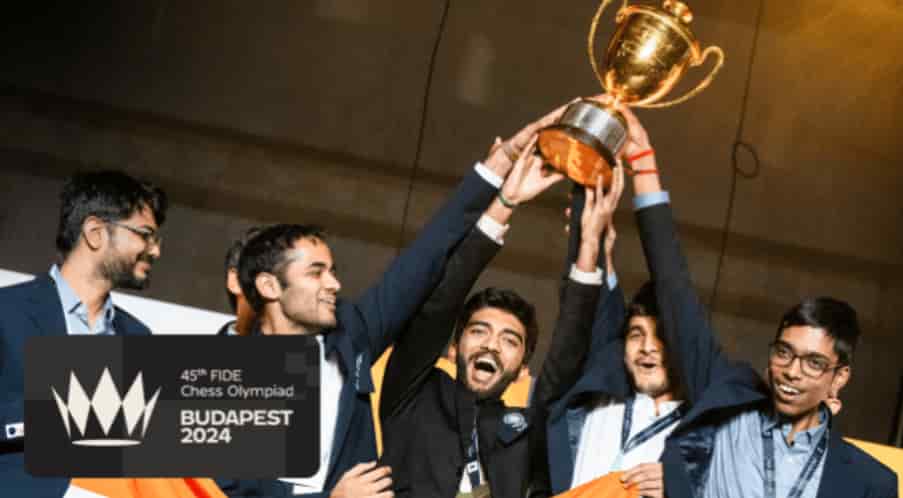
India’s historic triumph at the 45th Chess Olympiad in Budapest underscores its rise as a global chess power, led by a new generation of players.

There was perhaps no better way to show that India has arrived as a chess nation than by clinching its first-ever gold medal at the 45th edition of the Chess Olympiad, organized at Budapest (Hungary). With a record-breaking 193 teams in the Open section, this is the tournament where strength is measured by the depth of talent that a country possesses, and India’s spell-binding performance shows that the surge in the number of grand masters (GMs) isn’t just a number.
The Indian team won 10 matches and tied one to score 21/22 match points, beating the previous high of 20 by the U.S. and Ukraine in 2016, and finished a gaping four points clear of the “chasing pack.” The Women’s team suffered some setbacks, but also finished clear first, on 19/21, with no need for tiebreaks. The biggest team heroes among women were the youngest players, 21-year-old Vantika and 18-year-old Divya while the men’s team consisted of D. Gukesh, Arjun Erigaisi, R Praggnanandhaa and Vidit Gujrathi. Gukesh and Arjun are the sharp shooters while Praggnanandhaa and Vidit make a balance. What a perfect combination!
At the occasion of India’s remarkable success, it is time to think back to all the factors that have led up to it. One thing that was always present was the sacrifice of the parents.
India’s first Grand Master Vishwanathan Anand revealed in an article, “My mother used to accompany me to tournaments for years, till I was 15-16 years old and started travelling alone. Even then, she would come with me to a couple of places, as would my dad on several occasions. My parents put themselves out there a lot to support me. To some degree, that has been the case with the new crop of players too. Whether it is Gukesh D or Pragg (R Praggnanandhaa) or Vidit Gujrathi, their parents have been behind them like a wall, putting themselves through a lot personally to ensure that the boys have the support to go out and play to their best.
V. Anand says “While that has fairly been a constant, when I was growing up, coaching wasn’t such a big part of the game. I didn’t, for instance, have a coach until I was almost 20. By then, I was already one of the best players in the world. Things are different now. You can’t play without coaching. It’s much harder because of the amount of sophistication that training methods have acquired, and because of the competition. “
With so many kids playing chess now, particularly in Southern part of India, one has to ensure that one is a step ahead in the race. So, there is a huge amount of personal investment in coaches and support mechanisms. The tools of technology have exploded, forcing everyone to think of ways to maximise its benefits and include that in the training.
Until 2010, India had a total of 23 GMs. People knew about chess by the name of Viswanathan Anand, India’s first GM (Grand Master). Even though there were others, chess and its coverage were largely restricted to him. Now, the number of GMs has surged past 80. There are five players with a “Super GM” Elo rating of 2,700 or higher, five Indian players are ranked in the top 25 of the world, and one of them, D Gukesh, is going to battle for the title of world champion in November.
When the Chinese team won the Olympiad in 2018, most of the players in the team were aged. After that China started lagging behind in chess. But most of the players in India’s champion team are young. That is why India is an emerging as a bright spot in the world of chess and may remain a superpower in chess for the next 20 years.
FIDE Chess Olympiad is a massive team event for national federations that takes place every two years. We now have to wait another two years for the next edition, which will take place in Tashkent, the capital of Uzbekistan. Then in 2028 it’s Abu Dhabi, in the United Arab Emirates.


Join Our Newsletter
Related News
Opinion
You May Also Like
Read More
Discussion
Readers' Comments
Recent
EDITOR PICKS
POPULAR POSTS
MUST READ

ABOUT US
Town Post is a leading News Portal of Jamshedpur and Jharkhand.
FOLLOW US
Contact us: editor@townpost.net
© Town Post, Jamshedpur