
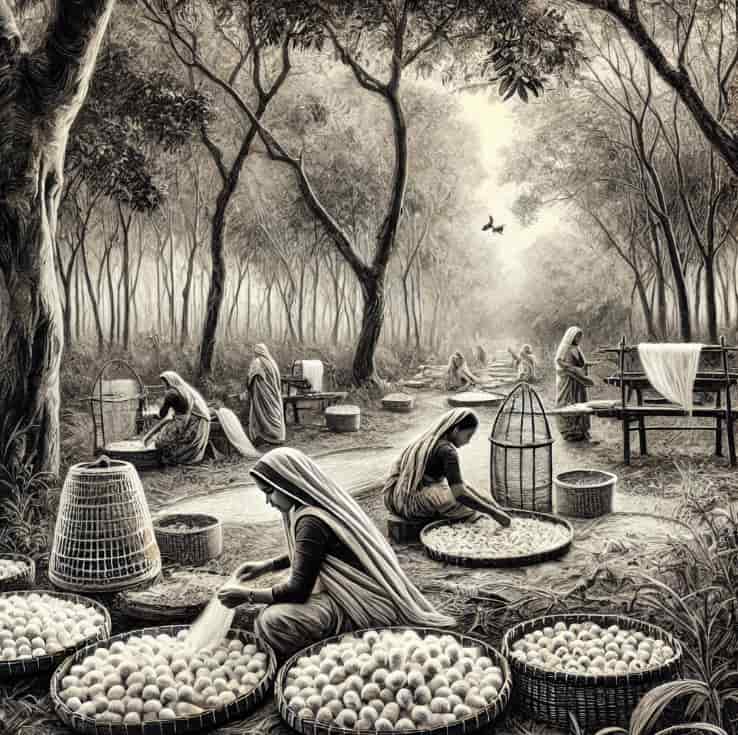
Tussar Silk: A nature’s blessing on Jharkhand

Tussar Silk: A nature’s blessing on Jharkhand
Tussar Silk From Jharkhand Gains Global Popularity for Its Unique Production Process, Sustainability, and Versatile Applications
Jharkhand’s Tussar silk industry thrives due to sustainable practices, local resources, and government support, propelling global demand for its distinct golden fabric.

Jharkhand is not only blessed with humongous mineral resources but its biodiversity is also vast and exemplary.
The wilderness comprises tropical moist deciduous and tropical dry deciduous forest. While the tropical dry deciduous forest constitutes 93.25% of the entire forestland, the remaining belongs to the tropical wet deciduous forest.
Major trees of Jharkhand are Sal, Shisham, Bamboo, Tendu, Shellac, Palm, Jamun, Sissoo, Mahua, Frondosa, Butea, Mango etc. Among the large number of trees found in Jharkhand ar e Arjun and Asan trees on which the tasar silkworms breed.
The silkworm breeding is famously called sericulture. In India tussar silk breeding is done in Bihar, West Bengal, Madhya Pradesh, ASsam, Chattisgarh and Jharkhand. Jharkhand is the largest producer of tussar in India.
The word tussar means wild because the silkworms don’t breed on mulberry trees but on those trees found in the wilderness. It is believed the term has come from the Sanskrit tasara meaning “to shuttle”. It is also known as tushar, tussore, tasar, tussur, tusser.
This silk is absolutely a nature product, unlike the mulberry silk obtained from domesticated silkworms fed on a controlled diet. Tussar silk is famous for its rich texture and deep gold color, but it can also range from creamy white to brown. It is highly breathable silk fiber, which accounts for its high demand in the warm Indian sub-continent climate.
Jharkhand is the largest producer of Tussar silk as the silkworms are fed leaves of arjuna, oak, asan, sal,cashew and Terminalia paniculata(kindal). Tussar silk is obtained by harvesting the silkworm species of the moth genus Antheraea including Antheraea mylitta, Antheraea mylitta, Antheraea proylei, Antheraea amamai.
They are introduced on arjun and asan trees along with sal, kindal etc. The main difference between the murlberry silk and tussar is that its produce is completely an non-violent process and is also known as ahimsa silk. In 2008, Jharkhand’s tasar silk was officially certified as organic silk.
The Antheraea moths lay eggs that hatch into larvae, which are fed tree leaves for growth. Once the larvae have fully transformed into puape and left the cocoons or are sun-dried, the cocoons are harvested. They are boiled in an alkaline solution to soften the fibers and extraction.
The soft silk obtainance depends on the time-length given inthe boil. The longer the softer emerges the silk. The filament end are carefully brushed out of the cocoon pulling and rubbing the cocoons on the kharpa(tiles) or thighs.
This process is entirely a female domain. The filament ends are joined and threaded together then wrapped around a loom. The filaments are thin and have a natural golden color. Then they are immersed inana acid solution then washed in a boiling solution of soap or washing soda.
The silk threads are woven into fabric using a loom. Tussar silk is classified into several types depending on the percentage of cotton blended with the silk in the warp.
Raw extracted tussar is often coarse, but the finished weave is smooth and silky, but durable.
The tussar silk industry is supported by the Central Silk Board and its subsidiary The Central Research and Training Institute in Ranchi. These organizations play a pivotal role in the research, development and training since its establishment in 1964.
The Jharkhand State Khadi and Gram Udyog undertake the training programs for weavers and improve the quality and design of the silk products.
The Jharkhand silk textile and handicraft development(Jharcraft) is responsible for promoting post-cocoon sericulture activities from cocoon to fabric. That is,the essential activities such as reeling , weaving and experimented tasks like painting and embroidery.
Tasar Development Foundation(TDF) runs livelihood projects in PRADAN(Professional Assistance for development action) non-government and a non-profit organization.
It was started in Godda district of Jharkhand through which the farmers sell their products “PALASH”.
SILKS(sericulture information linkages and knowledge system) central silk board. Under this the Ministry of Textile, Government of India, Bngalore made a silk park in Kharsawan, Jasidih and Giridih districts.
The Jharcraft has harnessed the advantage of the resources found in Jharkhand for tussar silk production environment by creating employment opportunities among the less-educated indigenous individuals. Jharcraft provide in-house one month training to hone their skills for spinning and weaving on the loom. As women are largely involved in this cottage industry they are trained under the women empowerment program schemes.
The institution Jharcraft provides the essential means such as looms to households involved in the filament extraction. This acts as an additional source of income along with their primary source. This results in both economic progress and the restoration of this cottage industry art. Jharcraft has given the artisans a platform by taking this craft to the international level.
Tussar silk products have received orders from several Asian countries like China, Malaysia, Dubai and beyond like Latin America. Most recently Jharcraft had put a stall in Chennai from 14th to 16th September where tussar silk was also on the stall along with other Jharkhand handicrafts.
Now the silk products are undergoing experimentation by adding synthetic dyes to the traditional yarns and also in forms. Apart from sarees and other dress materials the silk is now used to preapre furniture coverings, curtains, wall damasks. It is also used for embroidery such as kantha stitch.
The future of tussar silk seems to be bright creating an alternative and profit-making source of income for those subsumed in it.


Join Our Newsletter
Related News
Opinion
You May Also Like
Read More
Discussion
Readers' Comments
Recent
EDITOR PICKS
POPULAR POSTS
MUST READ

ABOUT US
Town Post is a leading News Portal of Jamshedpur and Jharkhand.
FOLLOW US
Contact us: editor@townpost.net
© Town Post, Jamshedpur