
Arnav Mishra Takes Charge as Dhalbhum SDO

Arnav Mishra Takes Charge as Dhalbhum SDO

IAS Officer Meets Deputy Commissioner, Receives Administrative Guidance
Key Points:
- 2023 batch IAS officer Arnav Mishra assumes Dhalbhum SDO post
- Deputy Commissioner emphasizes transparency and public welfare focus
- New appointment brings hope for faster development in subdivision
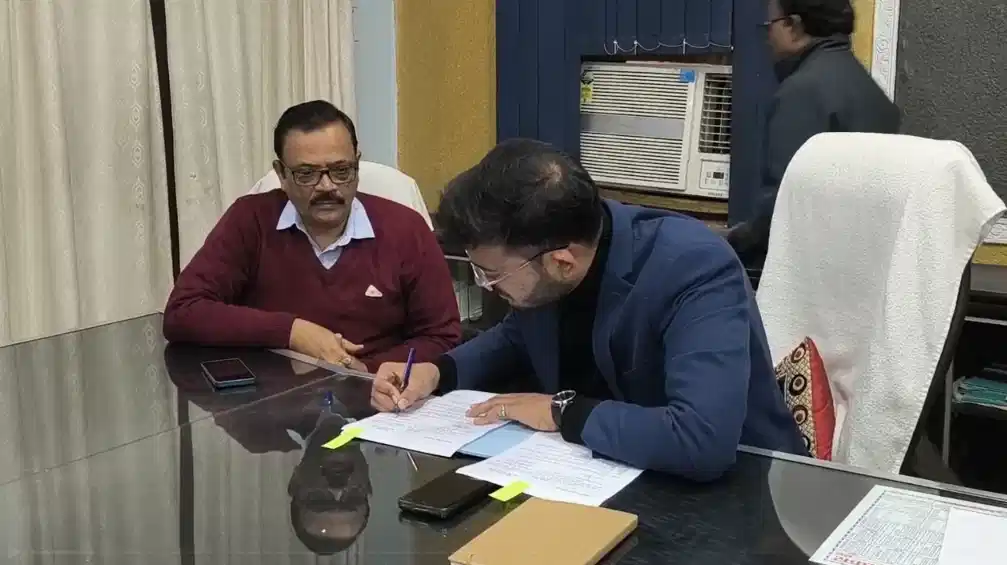
JAMSHEDPUR – Arnav Mishra formally assumed office as Dhalbhum Sub-Divisional Officer. The 2023 batch Indian Administrative Service officer took charge Friday.
The newly appointed SDO met District Magistrate cum Deputy Commissioner. He extended New Year greetings during the courtesy visit. Moreover, senior officials welcomed him to administrative responsibilities.
The Deputy Commissioner congratulated Mishra on his appointment. He provided guidance on handling administrative duties effectively. In addition, emphasis was placed on sensitivity and transparency.
Public welfare matters require swift execution, officials noted. Law and order maintenance demands strong administrative presence. Furthermore, subdivision governance must remain visible and accessible.
The DC stressed rapid disposal of citizen grievances. Effective administration needs proactive approach in field operations. Besides, development projects should maintain consistent momentum throughout.
Administrative circles express positive expectations from new officer. His appointment brings fresh energy to subdivision management. Meanwhile, residents hope for improved service delivery mechanisms.
Development work acceleration appears likely under new leadership. Citizen-related issues may receive faster resolution now. On the other hand, bureaucratic efficiency depends on ground implementation.
Mishra joins Dhalbhum subdivision at crucial administrative juncture. Multiple development projects await expedited clearances currently. However, coordination with various departments remains essential challenge.
The 2023 IAS batch officer carries administrative training. His fresh perspective may introduce innovative governance approaches. In contrast, local complexities require careful understanding gradually.
Deputy Commissioner outlined priority areas during interaction. Transparent functioning tops the administrative agenda comprehensively. Moreover, accountability mechanisms need strengthening across all levels.
Public interest cases demand immediate attention from officials. Legal processes should proceed without unnecessary delays. Furthermore, citizen grievances require systematic tracking and resolution.
Law and order situation needs constant monitoring. Police coordination becomes crucial for maintaining peace. Besides, preventive measures help avoid potential conflicts effectively.
The subdivision covers significant geographical area administratively. Multiple blocks require regular supervision and coordination. Additionally, remote villages need adequate administrative outreach programs.
Previous SDO initiatives established governance benchmarks locally. Mishra inherits operational framework from predecessor’s tenure. Meanwhile, continuity ensures ongoing projects remain unaffected significantly.
Administrative officials expect Mishra to visit field regularly. Ground-level understanding shapes effective policy implementation strategies. On the other hand, desk work requires equal attention simultaneously.
Revenue administration forms core responsibility of SDO position. Land disputes need fair and timely adjudication. Moreover, government schemes require proper monitoring and implementation.
Development programs span education, health and infrastructure sectors. Convergence among departments enhances project outcomes substantially. Furthermore, beneficiary identification processes demand careful scrutiny always.
Local body coordination strengthens grassroots governance considerably. Panchayat representatives provide valuable community insights regularly. Besides, joint efforts multiply administrative impact at village level.
The new officer’s tenure begins amid festive season. However, administrative work continues without seasonal interruptions. In addition, emergency response systems remain operational throughout year.


Join Our Newsletter
Related News
Opinion
You May Also Like
Read More
Discussion
Readers' Comments
Recent
EDITOR PICKS
POPULAR POSTS
MUST READ

ABOUT US
Town Post is a leading News Portal of Jamshedpur and Jharkhand.
FOLLOW US
Contact us: editor@townpost.net
© Town Post, Jamshedpur