
Padhega India Badhega India: True path of India’s development

Padhega India Badhega India: True path of India’s development
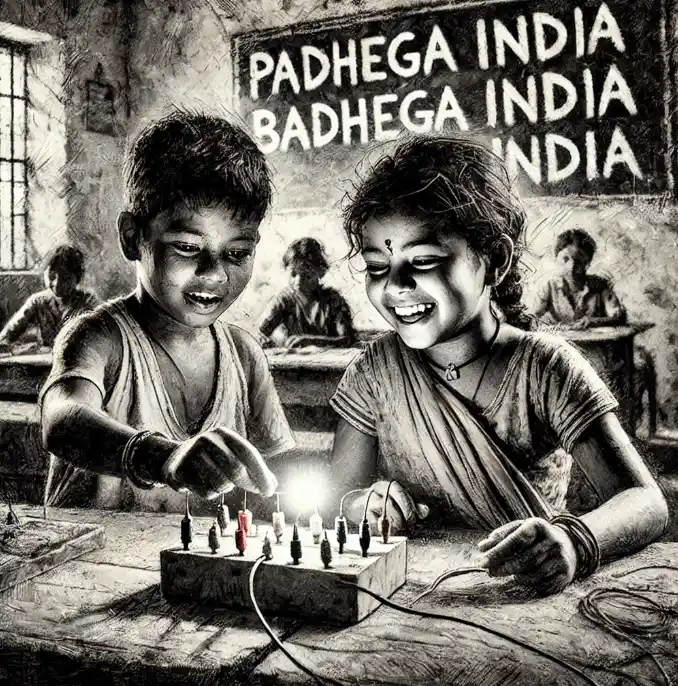
Young siblings in Karnataka save lives using lessons from school, embodying the transformative power of education in India’s growth.

A brother-sister duo in Karnataka applied their classroom understanding of electrical conductivity to save two lives, showcasing the potential of education in shaping a better India. This incident exemplifies the slogan “Padhega India Tabhi To Badhega India,” underlining how early education can lead to life-changing impacts.
Karnataka’s young brother-sister duo gaining the knowledge of electrical conductivity through their primary education saved two lives.
The incident became the embodiment of the slogan Padhega India Tabhi To Badhega India.
Education is the cornerstone of a civilization and the flourish of it depends on the tool of learning. The large number of public schools run by private institutions educate mostly the children of well-to-do families. The children of BPL and other financially deficit families usually stay away from learning processes and begin laboring from an age meant for studying and getting educated.
In India, 100% literacy is still a distant dream as the challenges for making education an universal entity is still much more grave than assumed.The reasons are several beginning from the lack of minimal facilities like unenough teaching staff.
Other than shortage of drinking water facility, lack of toilets in addition to other issues like the far distance school location, rough terrains, presence of water bodies and lack of bridges to cross them too lead to factors of low literacy rate and high school drop-out.
The school buildings’ poor conditions like absence of roofs, thatched leaky roofs, lack of desk-benches forcing the children to sit on floors in harsh seasons also play important roles in less attendance rate of children in schools.
In spite of the prevalent mid-day meal program, retaining students seemed an impossible task.
The better economic progress of a country in its elemental stage begins from the better and broader implementation of education policies to turn more minors inside the school premises and thus add them to the mainstream path of development and respect earned by their own endeavors.
The slogan of Padhega India Badhega India was mainly related to Kendriya Gramin Balika Vidyalaya (KGBV) in 2005 to address the low female literacy in the country.
This scheme began with creating awareness among the parents to educate the girl children considered secondary in most households.
The program in its initial stages faced the hindrance of poor infrastructure which was removed with the help of the famous private sector P & G global philanthropy program,‘P & G Live, Learn and Thrive’.
The schools chosen for this initiative belonged to Rajasthan and Jharkhand where female illiteracy was highly dominant.
The library and science laboratories were given priority along with ensuring teacher’s availability. Steps were taken to retain the attendance by providing health and menstrual hygiene education. Alongside other facilities like better classrooms, libraries etc.
If we talk about the last few decades, the special attention given in five-year plans began in 1994, when Narashima Rao government had launched the District Primary Education Program to enhance the primary education system.
Vajpayee’s Sarv Shiksha Abhiyaan was an extension to it which included opening new schools, alternative schooling facilities, toilet construction, making availability of drinking water system, provision for regular teachers, free textbook and uniform distribution.
Launched in 2001-2002, with the aim to achieve Universal Elementary Education(UEE) in India. It worked in partnership with the State Governments and Local Self Governments.
It was targeted to reduce the school drop-out rate especially of the children belonging to Scheduled Castes and Scheduled Tribes and the girl children. This campaign was launched in the digital media too to encourage more and more children to go to school. The very famous song School chalein hum became an instant hit after being aired on the national channel Doordarshan.
In 2009, the Right to Education Act was passed to impart free and compulsory education for children in the 6-14 age-group. The main ideology behind this act was to bestow the children a fearless, unanxious environment to study and learn.
By 2018-end another scheme called Samagra Shiksha Abhiyaan was launched absorbing the following active schemes: Rashtriya Madhyamik Shiksha Abhiyan(RMSA), Teacher Education and Sarva Shiksha Abhiyan.
The contemporaneous Cabinet approved continuation of Samagra Shiksha Scheme from 1st Apr 2021 to 31st Mar, 2016.
The honest implementation of these acts can guarantee an educated and progressive society in the coming times. And thus bring the much needed balance between the people belonging to different strata of life.


Join Our Newsletter
Related News
Opinion
You May Also Like
Read More
Discussion
Readers' Comments
Recent
EDITOR PICKS
POPULAR POSTS
MUST READ

ABOUT US
Town Post is a leading News Portal of Jamshedpur and Jharkhand.
FOLLOW US
Contact us: editor@townpost.net
© Town Post, Jamshedpur