
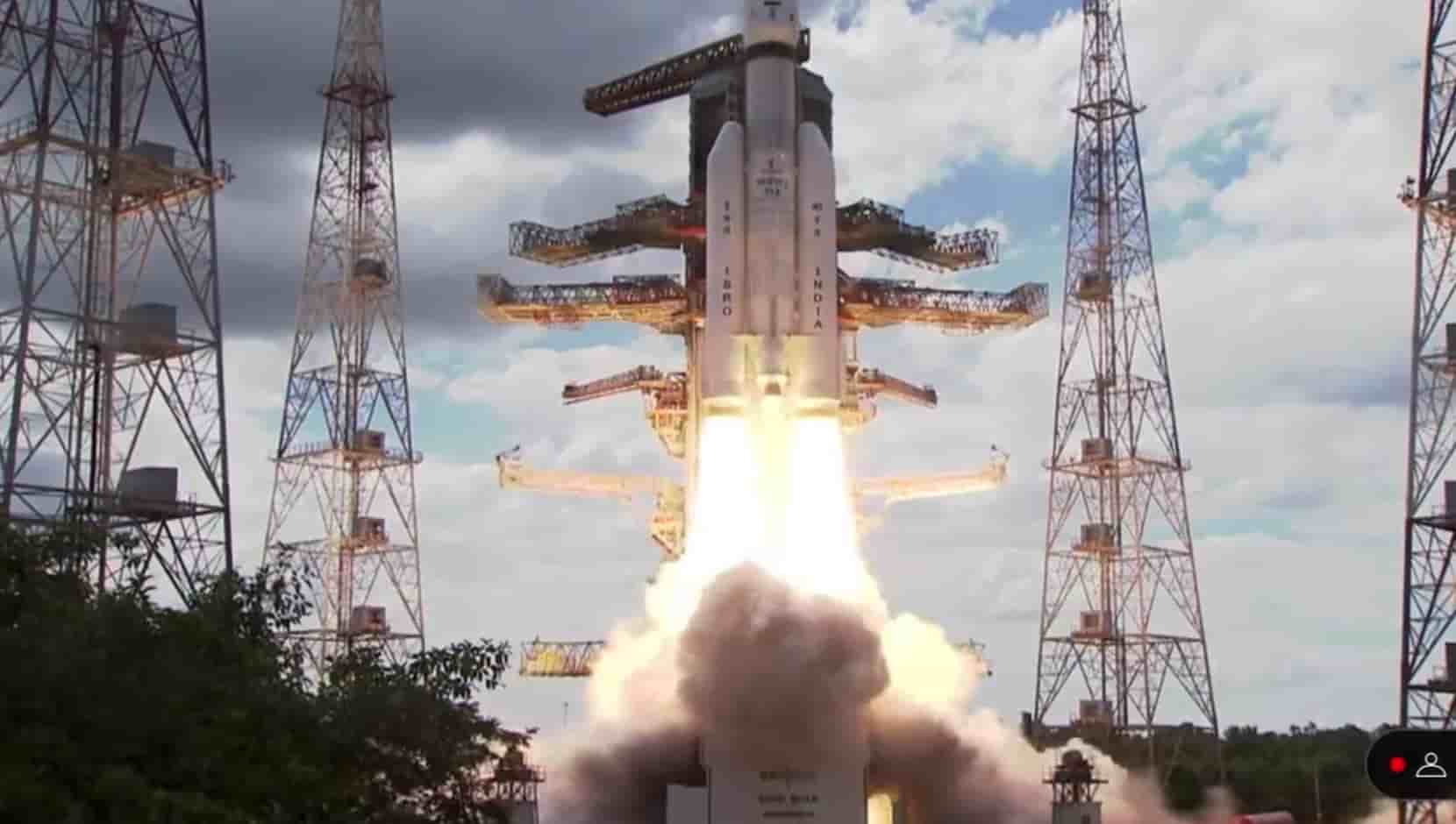
ISRO's Chandrayaan-3 Takes Off: India's Moon Mission Underway

ISRO’s Chandrayaan-3 Takes Off: India’s Moon Mission Underway

Chandrayaan-3, ISRO’s third lunar mission, successfully launches from Sriharikota, taking India a step closer to becoming the fourth country to land on the moon.
JAMSHEDPUR – A historic moment for Indian space research occurred on Friday, July 14, as the Chandrayaan-3 mission by the Indian Space Research Organisation (ISRO) lifted off at 2.35 PM IST.
The launch took place at the Satish Dhawan Space Centre in Sriharikota, Andhra Pradesh.
Mission Details
The Chandrayaan-3 mission is a follow-up to Chandrayaan-2, intending to reach the moon’s orbit, execute a soft landing on its surface, and dispatch a rover for lunar surface exploration.
The propulsion module separated from the rocket sixteen minutes post-lift-off, set to orbit Earth five to six times in an elliptical cycle before proceeding to the lunar orbit.
Journey and Landing
The spacecraft, carried by the GSLV Mark 3 heavy-lift launch vehicle, known as the ‘Bahubali rocket’, is expected to reach the moon in a 40-day journey.
Touchdown on the lunar surface is scheduled for August 23. In a significant development, Chandrayaan-3 aims to land on the moon’s South Pole, a site known for its water molecule deposits.
India’s Mooncraft Goals
Once settled, the moon lander, Vikram, will release the rover Pragyan to traverse the lunar surface for a lunar day—equivalent to 14 Earth days—and conduct various scientific experiments.
ISRO expects the rover to study the lunar soil, observe moonquakes, and provide extensive data about the moon’s surface.
Improved from Chandrayaan-2
Learning from the previous mission, ISRO has made several improvements, including reducing the number of engines on the lander from five to four, and implementing updated software.
ISRO Chief S Somnath explained that the new mission design could land successfully even in the event of specific component failures.


Join Our Newsletter
Opinion
Read More
Discussion
Readers' Comments
Recent
EDITOR PICKS
POPULAR POSTS
MUST READ

ABOUT US
Town Post is a leading News Portal of Jamshedpur and Jharkhand.
FOLLOW US
Contact us: editor@townpost.net
© Town Post, Jamshedpur