
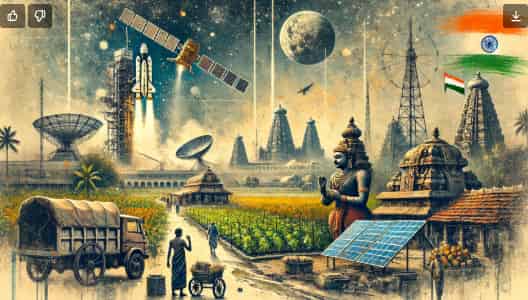
India’s sky-rocketing journey in Rocket Science

India’s sky-rocketing journey in Rocket Science
The success story includes phenomena from Space docking to growing plants in space
India’s space sector has achieved extraordinary milestones, including private satellite constellations, space docking, and groundbreaking experiments in space farming, showcasing its global prowess.

The year 2025 marks the 75th anniversary of the Indian Republic. In the year that has just passed and the beginning of 2025, India has scripted the story of its sky-rocketing journey in Space science. The efforts of ISRO have awarded India a unique position in the world of space exploration.
As we rocket into space on the back of several successful missions, this write up underscores India’s glorious space trajectory in the year that has passed.
Among the remarkable achievements of India in the field of Space, this is a matter of proud to convey that an Indian Space-Tech start-up, Bengaluru based Pixxel has successfully launched India’s first private satellite constellation – ‘Firefly’.
This satellite constellation is the world’s topmost high-resolution hyper spectral satellite constellation. This achievement has not only made India a leader in modern space technology, but is also a big step towards a Self-reliant India i.e. Aatma nirbhar Bharat.
A few days ago, the ISRO scientists marked another major achievement in the Space Sector when they undertook the space docking of satellites. When two Space crafts are connected in Space, this process is called Space Docking. This technology is important for sending supplies to Space Stations and crew missions in Space.
India has become the fourth country to achieve this success. Our scientists are also making efforts to grow plants in Space and make them survive. For this, ISRO scientists chose seeds of cow pea. Eight cowpea seeds in a closed-box environment with active thermal control were sent to outer space. These seeds, sent on the December 30, 2024 germinated in Space itself.
This is a very inspiring experiment which will pave the way for growing vegetables in Space in future. Another inspiring initiative is from IIT Madras’s ExTeM Centre. The centre is working on new technologies for manufacturing in Space and conducting research on technologies like 3D-printed buildings, metal foams and optical fibres in Space.
This Centre is also developing revolutionary methods like concrete construction without water. This research of ExTeM will strengthen India’s Gaganyaan mission and the future Space Station. All these achievements are proof of how visionary India’s scientists and innovators are, in providing solutions to future challenges.
Apart from the remarkable achievements of ISRO, India has collaborated with space agencies such as NASA, European Space Agency (ESA), Roscosmos and others on the world stage for its future projects.
India’s space programme, including its missions to the Moon and Mars, is often questioned in light of the country’s poverty. But the study shows that an investment in space research is anything but a vanity project.
Besides the obvious benefits, such as strengthening telecommunication, weather forecasting, GPS and so on, the space sector supports 4.7 million jobs in the country, a number that is set to go up as private payers foray into space research. India has reaped an over four-fold return on investments in its space programme in the last decade.
This data was released in September, 2024 after a study conducted by Novaspace, an international space sector consulting firm. Such handsome economic dividends were possible on account of the frugality of the Indian Space Research Organisation, which has added $60 billion to the Indian economy.
The TownPost team wishes ISRO to set new benchmarks in Space technology in the days ahead.


Join Our Newsletter
Related News
Opinion
You May Also Like
Read More
Discussion
Readers' Comments
Recent
EDITOR PICKS
POPULAR POSTS
MUST READ

ABOUT US
Town Post is a leading News Portal of Jamshedpur and Jharkhand.
FOLLOW US
Contact us: editor@townpost.net
© Town Post, Jamshedpur