
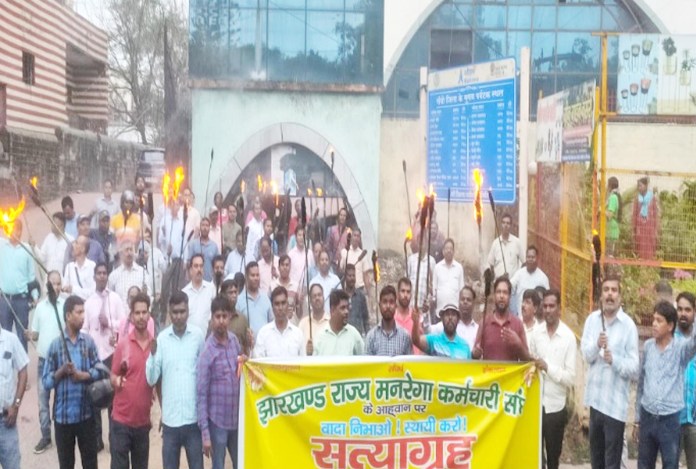
MGNREGA Workers Launch Indefinite Strike in Jharkhand

MGNREGA Workers Launch Indefinite Strike in Jharkhand

5,000+ Employees Demand Job Security and Better Benefits
Indefinite strike by MGNREGA workers in Jharkhand threatens to disrupt crucial rural development schemes and wage disbursements.
RANCHI – Over 5,000 MGNREGA workers across Jharkhand have initiated an indefinite strike, raising concerns about the continuity of vital rural development programs.
The strike, which commenced on Monday, stems from long-standing demands for job security and improved social benefits.
Rozgaar Sevaks, computer operators, engineers, and BPO workers are among those participating in the work stoppage.
The industrial action is expected to impact several key initiatives, including the Birsa Irrigation Promotion Well and Abua Awas schemes.
"We’ve dedicated our youth to government service, and now we’re worried about our future as we age," expressed a striking worker.
The protesters highlighted their unwavering commitment during the COVID-19 pandemic, when they continued to provide employment despite personal risks.
John Bagge, the state president of the workers’ association, has issued a letter detailing their demands for service rule amendments.
The striking employees are pushing for the implementation of permanent service grades to ensure long-term job stability.
Workers criticized the government for making empty promises and failing to address their concerns despite numerous protests.
Previous demonstrations included a gherao of the Rural Development Minister’s residence and a 100 km pad yatra.
The strike threatens to delay wage payments for approximately 250,000 laborers reliant on MGNREGA for their livelihood.
MGNREGA, a flagship program of the Rural Development Department, has been operating in the state for 17 years.
The workers emphasized their crucial role in block-level operations and the scheme’s implementation across Jharkhand.
Government officials have yet to respond to the strike, leaving the fate of ongoing rural development projects uncertain.
Local communities express concern over potential delays in essential infrastructure and employment generation initiatives.


Join Our Newsletter
Opinion
You May Also Like
Read More
Discussion
Readers' Comments
Recent
EDITOR PICKS
POPULAR POSTS
MUST READ

ABOUT US
Town Post is a leading News Portal of Jamshedpur and Jharkhand.
FOLLOW US
Contact us: editor@townpost.net
© Town Post, Jamshedpur