
Varanasi's Gyanvapi Complex Under Archaeological Examination

Varanasi’s Gyanvapi Complex Under Archaeological Examination

A Historical Quest Begins: ASI Survey Probes the Grounds of Gyanvapi Mosque

Sheo Prasad Pramanik
Since August 2, 2023, the Gyanvapi mosque complex in Varanasi has become the epicenter of a historical quest led by the Archaeological Survey of India (ASI).
This investigation aims to unravel the layers of history, to confirm or debunk the claim that a Hindu temple existed on the grounds where the 17th-century mosque stands today.
The survey comes in response to a lawsuit filed by four Hindu women in the Varanasi district court.
The plaintiffs assert that the Gyanvapi mosque was erected on the remnants of a Hindu temple. They further claim that a shivling, a symbolic representation of the Hindu deity Shiva, is present within the mosque’s premises, and they are seeking legal permission to offer prayers there.

Despite the historical and religious significance of the investigation, it has not been met with unanimous approval.
The Muslim community, in particular, has expressed dissent, interpreting the survey as a violation of their sanctum of worship.
Legal Battle and Community Response: Anjuman Intezamia Masjid vs. Supreme Court
The Anjuman Intezamia Masjid committee, entrusted with the mosque’s administration, has put forth an appeal to the Supreme Court, calling for an injunction on the survey.
In the face of the committee’s concerns, the Supreme Court, while acknowledging the plea, declined to halt the survey.
The court, however, issued instructions to the ASI to refrain from employing intrusive methods during the course of the investigation.
The ASI, in turn, committed to adhering to the court’s directives.
The Impending Verdict: Possible Outcomes and their Repercussions
The survey’s results promise to be contentious. The Muslim side fears that the discovery of evidence proving that the mosque was constructed atop a Hindu temple could lead to calls for its demolition or conversion into a Hindu temple. However, conversely, the absence of any remnants of a Hindu temple could be perceived as a victory by the Muslim community.
Simultaneously, the Gyanvapi mosque is mired in a web of legal disputes, including the ongoing ASI survey.
On another front, the Supreme Court is considering a petition filed by the Hindu community seeking permission to conduct prayers at the purported shivling within the mosque premises.

A ruling on this matter is anticipated in the forthcoming months.
Future of Gyanvapi Mosque: A Reflection of India’s Religious Landscape
The fate of the Gyanvapi mosque, and by extension, the religious harmony in Varanasi, and possibly the entire country, lies in the balance, hanging on the verdict of the ASI survey and the pending Supreme Court lawsuit.
The assertion that the mosque was constructed on a former Hindu temple site has been challenged by the Muslim side. The Muslim side feels that let bygones be bygones policy should be adhered and old wounds should not be opened.
However, the Hindu side feels that historical injustices must be corrected in a legal manner and if the mosque stands atop a temple, the structure must be given back to the Hindu side.
Although the ASI survey is a delicate and divisive subject, it is also an important one.
On the future of the Gyanvapi mosque and on India’s religious landscape, the survey’s results will have a substantial influence.
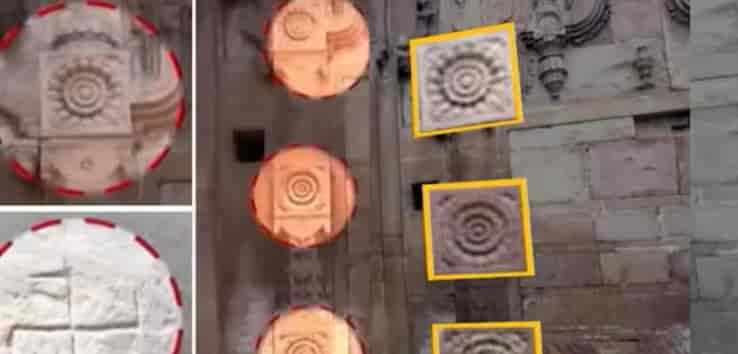
The Hindu side’s attorney, Sudhir Tripathi, stated that during the current Archaeological Survey of India (ASI) investigation of the Gyanvapi mosque complex in Varanasi, they had uncovered fragments of idols amidst the debris.
A Country Waits in Anticipation
With all eyes on the ASI survey, the country waits in anticipation for its conclusion.
While it may take several weeks to complete the survey, the findings could have a long-lasting impact on the religious and socio-political landscape of the nation.
The Hindus have been waiting for decades for the wheel of justice to rotate their way. They feel that it is an irony that in the only country where they are in majority, the all the three most important symbols of their culture, Mandirs of Shri Rama, Shri Krishna and Bhagwan Shiva, had been occupied and disfigured by Muslim invaders and that even after seven decades of independence, the state has failed in restoring their cultural and religious dignity.
However, they have been waging a long legal battle in the hope that some day their cultural and religious heritage would be restored to them, who are the rightful owners of these mandirs.


Join Our Newsletter
Related News
Opinion
You May Also Like
Read More
Discussion
Readers' Comments
Recent
EDITOR PICKS
POPULAR POSTS
MUST READ

ABOUT US
Town Post is a leading News Portal of Jamshedpur and Jharkhand.
FOLLOW US
Contact us: editor@townpost.net
© Town Post, Jamshedpur