
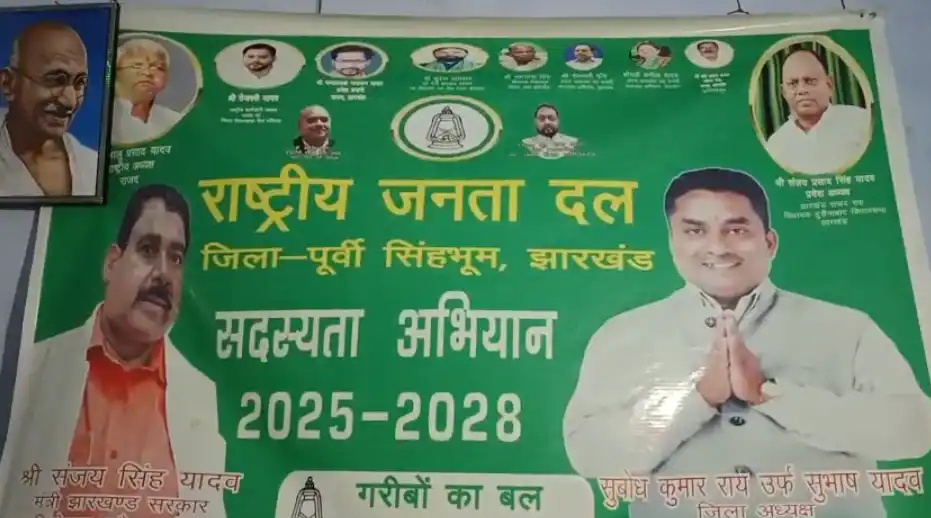
RJD Jamshedpur Unit Faces Leadership Dispute Over Election

RJD Jamshedpur Unit Faces Leadership Dispute Over Election

Executive Committee Alleges Money Exchanged in District President Selection
Key Points:
- Executive committee challenges legitimacy of current district president
- Allegations of bribery in district election officer’s decision making
- State leadership reportedly kept uninformed about controversial appointment
JAMSHEDPUR – Rashtriya Janata Dal’s district committee faces deepening internal conflict as executive members challenge the current president’s appointment through alleged irregular processes.
The executive committee organized a press conference recently. Multiple office bearers attended the gathering. Executive district president participated in the discussion. Moreover, OBC cell chairman joined the meeting.
Minority cell chairman also remained present. Several other office bearers supported the allegations. However, the controversy centers around irregular appointment procedures.
Committee members accused former district election officer of misconduct. They alleged money changed hands during selection process. Furthermore, the officer reportedly declared Sambhu Chaudhary as president illegitimately.
“The election officer took bribes for the appointment,” claimed a committee member. State leadership remained unaware of these developments. Meanwhile, provincial officials were deliberately kept uninformed.
The executive committee revealed additional concerning details. Some state committee office bearers allegedly participated in irregularities. These officials reportedly supported the controversial appointment process. Nevertheless, evidence suggests systematic manipulation occurred.
Committee members approached state leadership for resolution. They shared comprehensive information with provincial president. The state president assured fair investigation into allegations. Moreover, he promised justice for longtime party workers.
“We will ensure impartial decision making,” stated party sources. Veteran workers deserve proper representation within organizational structure. However, the current dispute threatens party unity.
The controversy highlights internal governance challenges. Electoral processes require transparent oversight mechanisms. Furthermore, money influence undermines democratic party functioning.
State intervention appears necessary for conflict resolution. Provincial leadership must investigate all corruption allegations thoroughly. Meanwhile, affected workers await administrative action.
The dispute affects local party operations significantly. Organizational activities face disruption due to leadership questions. However, resolution depends on state committee intervention.
Committee members demand immediate corrective measures. They seek removal of allegedly corrupt officials. Moreover, fresh elections under proper supervision remain essential.
Sources said that the controversy exposes systemic weaknesses in party structure. Internal democracy requires stronger protective mechanisms. Furthermore, accountability measures need immediate implementation.


Join Our Newsletter
Related News
Opinion
You May Also Like
Read More
Discussion
Readers' Comments
Recent
EDITOR PICKS
POPULAR POSTS
MUST READ

ABOUT US
Town Post is a leading News Portal of Jamshedpur and Jharkhand.
FOLLOW US
Contact us: editor@townpost.net
© Town Post, Jamshedpur