
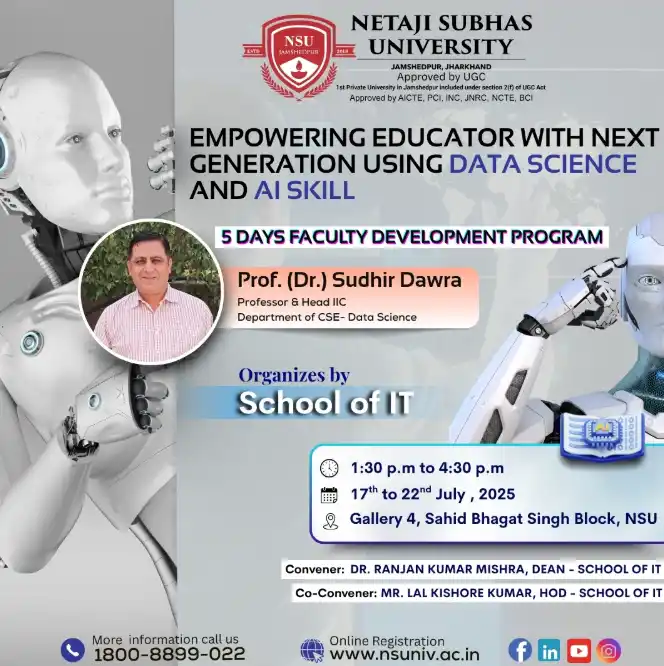
Netaji Subhas University Launches Five-Day AI Faculty Program

Netaji Subhas University Launches Five-Day AI Faculty Program

School of IT Inaugurates Data Science Training for Educators
Key Points:
- Five-day faculty development program begins at NSU Jamshedpur
- Prof. Sudhir Dawra delivers keynote on AI in education
- Program focuses on next-generation teaching methodologies
JAMSHEDPUR – Netaji Subhas University inaugurated a comprehensive faculty development program focusing on artificial intelligence and data science skills for educators.
The School of IT at Netaji Subhas University commenced its ambitious five-day Faculty Development Program on July 17, 2025. Dr. Ranjan Kumar Mishra, Dean of School of IT, spearheaded the initiative. Meanwhile, Mr. Lal Kishore Kumar, Head of Department, provided organizational support.
Prof. Sudhir Dawra from the Department of CSE-Data Science delivered the keynote address. He emphasized the critical need for faculty integration of emerging technologies. Moreover, he highlighted the paradigm shift in modern teaching methodologies.
The distinguished professor discussed AI applications in academic systems extensively. He also addressed smart content delivery mechanisms. Furthermore, ethical considerations in AI adoption formed a significant portion of his presentation.
Faculty members from multiple departments attended the inaugural session enthusiastically. However, the program extends beyond traditional lecture formats. Hands-on sessions will complement theoretical discussions throughout the week.
The comprehensive training program continues until July 22, 2025. Expert talks will feature prominently in the curriculum. In addition, collaborative activities aim to enhance technical competencies.
Data-driven decision-making emerged as a central theme during discussions. AI-powered educational tools received particular attention from participants. Besides, the program addresses global industry alignment requirements.
The university’s initiative reflects growing demand for technology-enhanced pedagogy. Academic institutions increasingly recognize the importance of faculty upskilling. Consequently, such programs bridge the gap between traditional and modern teaching approaches.


Join Our Newsletter
Related News
Opinion
You May Also Like
Read More
Discussion
Readers' Comments
Recent
EDITOR PICKS
POPULAR POSTS
MUST READ

ABOUT US
Town Post is a leading News Portal of Jamshedpur and Jharkhand.
FOLLOW US
Contact us: editor@townpost.net
© Town Post, Jamshedpur