
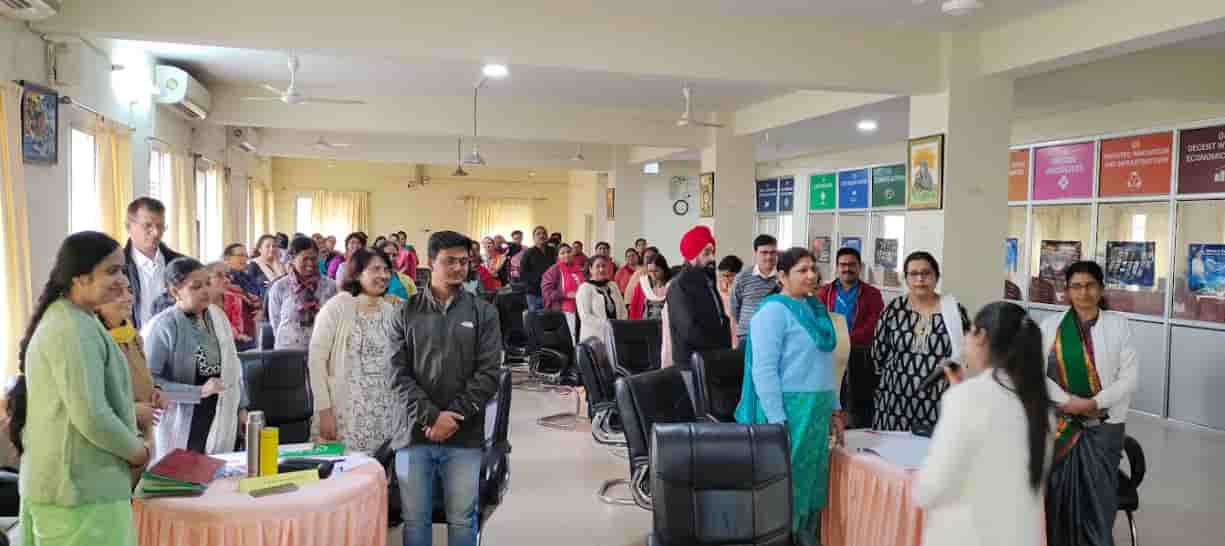
CBSE-Backed Training Workshop Held for Teachers in Jamshedpur

CBSE-Backed Training Workshop Held for Teachers in Jamshedpur

DAV Public School, Bistupur, organized the Capacity Building Programme on 30 November 2024.
Key Points:
-
Workshop aimed to enhance learning outcomes and teaching pedagogies.
-
Sessions focused on Bloom’s Taxonomy and student-centered approaches.
-
Resource persons stressed measurable skills and holistic student development.
JAMSHEDPUR – DAV Public School, Bistupur hosted a Capacity Building Programme to train teachers on effective learning methodologies and outcomes.
The workshop commenced with the DAV GAAN and the lighting of the ceremonial lamp.
Mrs. Pragya Singh, ARO of DAV Public Schools for Jharkhand Zone E and Principal of the host school, welcomed resource persons and participating teachers.
She emphasized lifelong learning as crucial for students’ academic and holistic development.
Session Highlights
In the opening session, Ms. Mousumi Das, Principal of SDSM Centre for Academic Excellence, focused on student-centered learning outcomes.
She elaborated on how students can demonstrate acquired skills, knowledge, and values after completing a course.
The session also detailed Bloom’s Taxonomy, emphasizing ways teachers can create a supportive environment for learning.
Interactive discussions included activities to improve students’ abilities, attitudes, and knowledge.
Practical Applications of Bloom’s Taxonomy
Ms. Paridhi Singh, Teacher Co-ordinator at Jamshedpur Public School, led the second session.
She discussed measurable learning outcomes and interactive methods to implement Bloom’s Taxonomy in classroom settings.
Her insights showcased practical strategies to ensure that teaching practices cater to diverse student needs.
Teachers were encouraged to explore innovative ways to enhance classroom engagement.
Concluding Strategies
The final session, led by Ms. Mousumi Das, introduced a fresh approach to child-centered education.
She stressed the importance of creating equitable opportunities for all learners.
Practical tips were shared on tailoring pedagogies to support individual learning needs.
Participants left with actionable insights to foster inclusive and effective learning environments.
One attendee shared, “The sessions have empowered us with new techniques to meet modern teaching challenges.”
The program concluded with optimism and a collective resolve to enhance teaching practices.


Join Our Newsletter
Opinion
Read More
Discussion
Readers' Comments
Recent
EDITOR PICKS
POPULAR POSTS
MUST READ

ABOUT US
Town Post is a leading News Portal of Jamshedpur and Jharkhand.
FOLLOW US
Contact us: editor@townpost.net
© Town Post, Jamshedpur