
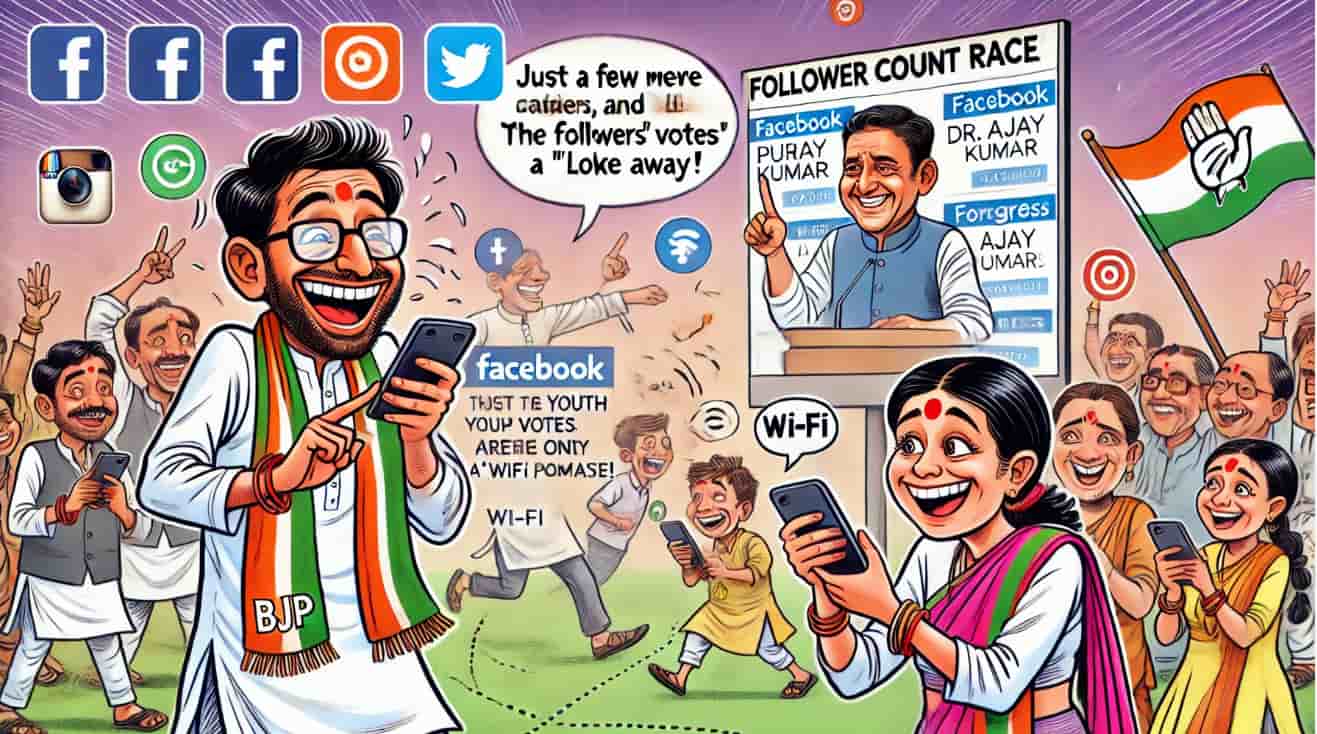
Jharkhand Assembly Elections 2024: Politics on social media
Jharkhand Assembly Elections 2024: Politics on social media
With Jharkhand assembly elections approaching, candidates leverage social media to influence voters and share promises directly, transforming political campaigning.
Social media has become a pivotal tool in Jharkhand’s assembly elections, allowing candidates to engage with voters, amplify campaign activities, and shape public opinion. Digital platforms are enhancing voter outreach across urban and rural regions alike.

In the last few parliamentary and assembly elections, social media has emerged as a powerful medium of election campaign.
It is playing a key role in connecting with voters and understanding their mood. Candidates are not only appealing for votes through it, but are also conveying their election promises to the public.
After the announcement of Jharkhand assembly elections, while candidates are running public relation campaigns through various media, social media has proved to be an effective tool for them in connecting directly with voters and influencing the electorates. Along with connecting with people through Pad yatra and public meetings, almost all the candidates and their supporters are active on social media and are working under a strategy.
Most of the candidates have created their own pages on social media on which they are regularly updating the activities of their election campaign. Candidates are also spending money to promote the page. Many candidates have also hired agencies for this. Agencies are giving momentum to the election campaign of the candidate. The IT teams of major political parties are active on Facebook, Twitter (now X), Instagram and WhatsApp. Party supporters and leaders are putting posts that influence people in their own ways, while supporters are giving their support by liking and commenting on their posts. Since the day of nomination, pictures are being posted.
Talking in local context, there is a competition among the candidates of Jamshedpur East and Jamshedpur West seats to increase their followers and reach. BJP candidate from Jamshedpur East Assembly seat Purnima Sahu has more than 18,000 followers on Facebook account and 3203 followers on Instagram.
Similarly, Congress candidate Dr. Ajay Kumar has more than 80,000 followers on Facebook, one lakh 21 thousand plus followers on X and 4356 followers on Instagram. Independent candidate Shiv Shankar Singh from Jamshedpur East has 10000 plus followers on Facebook and 5884 followers on Instagram. Independent Rajkumar Singh has 1133 followers on Instagram, while he has more than 59,000 followers on Facebook. Similarly, Congress candidate from Jamshedpur West and Minister, Govt. of Jharkhand, Banna Gupta has more than 30,000 followers on Facebook page while he has 3547 followers on Instagram. NDA candidate from Jamshedpur West Saryu Rai has 12,021 followers on Facebook and 3391 followers on Instagram. Independent candidate Vikas Singh has 11,000 followers on Facebook and 817 followers on Instagram.
Similarly, independent Shambhu Chaudhary has 1,292 followers on Instagram and 11,000 followers on Facebook.
Political parties are using youth having knowledge of modern technology to create social media related content. Through this, employment has also been provided to the youth. This path engages young generation more in political participation. However, in rural areas, the ability to use social media effectively and efficiently is less. Due to this, college youth are being provided employment by making them a part of the social media team. Candidates and their supporters are posting messages by sharing reels, pictures on social media.
Regarding the persuasion of voters through social media for casting their vote in favour of desired candidate or party, social media has played key role in few cases. This new information and communication technology has become the bridge between the public and political parties.


Join Our Newsletter
Related News
Opinion
You May Also Like
Read More
Discussion
Readers' Comments
Recent
EDITOR PICKS
POPULAR POSTS
MUST READ

ABOUT US
Town Post is a leading News Portal of Jamshedpur and Jharkhand.
FOLLOW US
Contact us: editor@townpost.net
© Town Post, Jamshedpur