
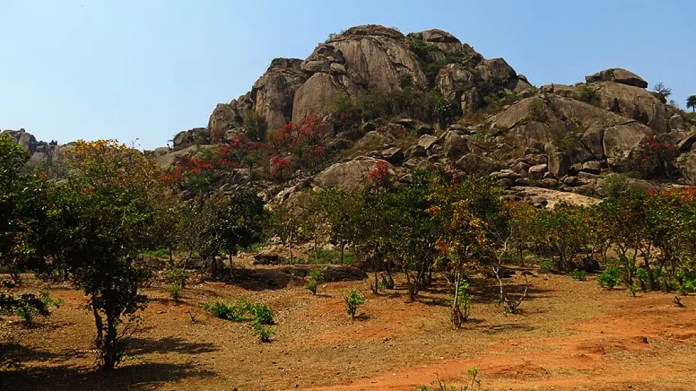
World's Oldest Beach Discovered in Jharkhand's Singhbhum

World’s Oldest Beach Discovered in Jharkhand’s Singhbhum

Research dates ancient shoreline to 3.2 billion years ago, reshaping continental formation theories
Groundbreaking study reveals Singhbhum district as the site of Earth’s earliest known beach, predating previous estimates of continental emergence by 700 million years.
JAMSHEDPUR – A recent study published by the National Academy of Sciences of America has identified Singhbhum district in Jharkhand as the location of the world’s oldest beach, dating back approximately 3.2 billion years.
"This discovery fundamentally alters our understanding of continental formation," stated Chaudhary Priyadarshi, lead researcher from Monash University, Australia.
The research team analyzed zircon particles from 3.1 billion-year-old rocks in Singhbhum, finding evidence of ancient rivers and seas.
These findings suggest the presence of continents in Jharkhand much earlier than the previously accepted timeline of 2.5 billion years ago.
The Singhbhum Craton, a stable ancient part of the Earth’s crust, is believed to have emerged from the sea around 3.2 billion years ago.
"Cratons like Singhbhum formed the initial cores of large landmasses," explained a local geologist familiar with the research.
Similar ancient cratons have been identified in South Africa and Australia, supporting the global significance of this discovery.
The study challenges existing theories about continental formation and the role of plate tectonics in this process.
This revelation positions Singhbhum as a crucial site for understanding Earth’s early geological history.
The ancient beach, located approximately 300 kilometers from modern-day Puri beach in Odisha, offers new insights into the planet’s primordial landscape.


Join Our Newsletter
Opinion
You May Also Like
Read More
Discussion
Readers' Comments
Recent
EDITOR PICKS
POPULAR POSTS
MUST READ

ABOUT US
Town Post is a leading News Portal of Jamshedpur and Jharkhand.
FOLLOW US
Contact us: editor@townpost.net
© Town Post, Jamshedpur