
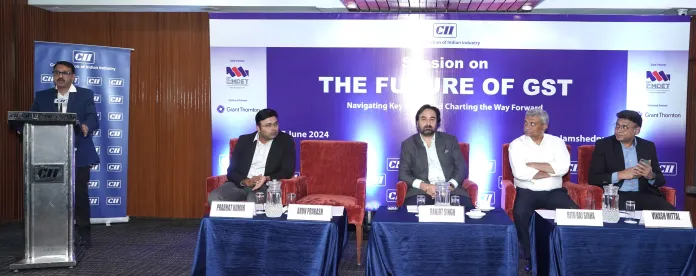
CII Jamshedpur Hosts Conference on the Future of GST and its Impact on Economy and Industry

CII Jamshedpur Hosts Conference on the Future of GST and its Impact on Economy and Industry

Experts Discuss GST 2.0, Compliance Culture, and Role of Technology in Tax Reforms
CII Jamshedpur organized a conference to explore the evolution of India’s GST system and its implications for the economy, industry, and citizens.
JAMSHEDPUR – The Confederation of Indian Industry (CII) Jamshedpur conducted a thought-provoking conference titled "The Future of GST: Navigating Key Issues and Charting the Way Forward" to delve into the progression of India’s Goods and Services Tax (GST) system and its ramifications for the economy, industry, and the general public.
Ritu Raj Sinha, Vice Chairman of CII Jharkhand State Council & Managing Director of Tata Steel UISL, kickstarted the conference with an in-depth discussion on GST 2.0.
He emphasized the importance of a clear understanding of GST for driving the country, industry, and economy forward, and highlighted CII’s commitment to simplifying complex modifications for better public understanding and implementation.
GST as a Catalyst for Compliance and Economic Growth
Arun Prakash, Convenor of CII Jharkhand Economic Affairs, Finance & Taxation Panel & Senior General Manager (Finance) at Tata Cummins Pvt Ltd, shared his perspective on the future of GST in India.
He emphasized that GST goes beyond mere tax collection, fostering a culture of compliance, simplifying business operations, and promoting a more equitable and progressive economic system.
Prakash praised the "One Nation, One Tax" theme for unifying tax reforms, eliminating cascading effects, reducing tax barriers, and streamlining administration, ultimately enhancing efficiency and competitiveness.
Collaborative Learning and Policy Revision
Ranjot Singh, Chairman of CII Jharkhand State Council & Managing Director of Emdet Jamshedpur Pvt Ltd, discussed the collaborative learning process between the government and industry.
He highlighted the efficiency of GST in promoting economic growth but noted that policies relevant in 2017 may need revision to remain effective in subsequent years.
Singh affirmed CII’s role in simplifying complexities and advocating for industry issues with the government.
GST as a Cornerstone of Tax Reforms
Vikash Mittal, Co-Convenor of CII Jharkhand Economic Affairs, Finance & Taxation Panel & Chief Legal Counsel for Indirect Taxation at Tata Steel Limited, described GST as a cornerstone of India’s tax reforms, emphasizing its role in bringing simplicity, efficiency, and transparency to the country’s indirect taxation framework.
Technology and Compliance in GST 2.0
Karan Kakkar, Partner at Grant Thornton Bharat LLP, discussed the evolution of GST 2.0 and its significant reforms since 2017.
He highlighted the critical role of technology in GST implementation, noting that GST 2.0 aims to enhance efficiency, ensure transparency, and simplify compliance for both businesses and government entities.
Broadening Tax Base and Supporting Small Businesses
Balram Pandey, Director of Indirect Tax at BDO India LLP, focused on government efforts to broaden the tax base by reducing tax rates and promoting compliance through digitalization.
He addressed the challenges businesses face with compliance and the importance of training and support for small businesses.
Litigation Risks and Contractual Agreements
Pratik Shah, Associate Partner for Indirect Tax at BDO India LLP, highlighted issues such as the mismatch between VAT and purchasing details, and the need for robust litigation mechanisms.
He discussed strategies for businesses to safeguard against litigation risks and the importance of clear contractual agreements in service supply chains.
The CII Jamshedpur conference provided a platform for experts to share insights on the future of GST and its impact on the economy and industry, emphasizing the need for continuous collaboration, policy revisions, and technological advancements to ensure a more efficient and transparent tax system.


Join Our Newsletter
Opinion
You May Also Like
Read More
Discussion
Readers' Comments
Recent
EDITOR PICKS
POPULAR POSTS
MUST READ

ABOUT US
Town Post is a leading News Portal of Jamshedpur and Jharkhand.
FOLLOW US
Contact us: editor@townpost.net
© Town Post, Jamshedpur