
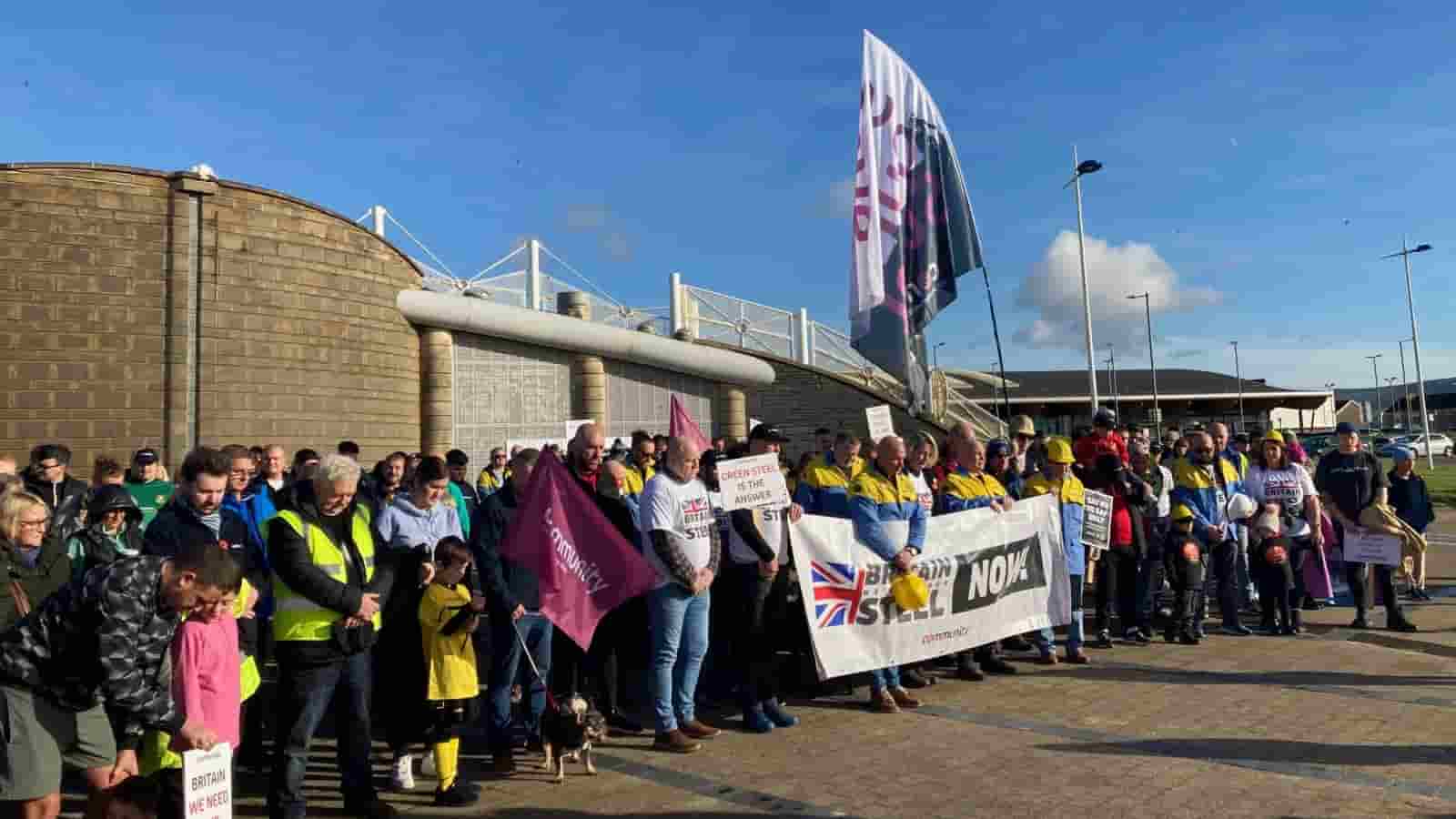
Unions Challenge Tata Steel's Port Talbot Closure Plan

Unions Challenge Tata Steel’s Port Talbot Closure Plan

Tata Steel’s Job Cut Plan Faces Union Resistance, Alternative Proposed
Unions propose an alternative to Tata Steel’s plan for Port Talbot, aiming to save jobs and sustain UK steelmaking.
WORLD DESK – Union leaders have confronted Tata Steel with a critical ultimatum: keep a blast furnace at Port Talbot steelworks operational until 2032 to secure the future of the company’s UK steelmaking. This move is part of a desperate effort to prevent the loss of 3,000 jobs.
Tata Steel was close to announcing the imminent closure of two blast furnaces at Port Talbot but paused to consider the unions’ arguments.
Community and GMB, two major unions, are endorsing proposals from consultancy Syndex, presented to Tata Steel in a bid to avoid the job losses and economic impact on Port Talbot.
Contrarily, Unite, another key union, has publicly opposed the potential job cuts in the alternative plan.
Tata Steel, owned by the Indian conglomerate, is contemplating shutting down most operations at Port Talbot, a site with a 5 million tonnes steel production capacity per year. The company’s plan involves transitioning to greener electric arc furnaces, operational from 2027, requiring fewer long-term workers.
The UK government supports Tata’s transition with a £500m pledge but faces union and political pressure for job guarantees.
The Syndex proposal suggests a two-stage transition to electric arc furnaces, potentially saving 2,000 jobs.
In the first phase, one blast furnace would remain active, supporting production for automotive and food tin customers like Nissan and Heinz. It would also supply iron for the initial electric arc furnace alongside scrap metal.
The plan entails closing the second blast furnace in 2032, coinciding with the construction of another electric arc furnace.
Community’s national officer for steel, Alun Davies, reported positive talks with Tata. A Community spokesperson deemed the plan achievable without compulsory redundancies, calling it "credible and deliverable."
However, Unite’s opposition, led by general secretary Sharon Graham, complicates negotiations, as the union firmly opposes any job losses.
A Tata Steel spokesperson confirmed they would review the union’s plan, engaging in formal consultations with employee representatives.
The union analysis challenges Tata’s single large electric arc furnace plan as technologically demanding and risky in securing high-quality scrap metal. They suggest maintaining a blast furnace and initially building a smaller electric arc furnace to mitigate grid connection delays.
The transition plans by Tata Steel and British Steel mark a pivotal moment in British industrial history, potentially ending large-scale steel production from iron ore in the UK since the industrial revolution.
Community and GMB advocate for additional technology investments, such as direct reduced iron (DRI) processes, to produce iron from ore using zero-carbon hydrogen, aligning with environmental goals.


Join Our Newsletter
Related News
Opinion
You May Also Like
Read More
Discussion
Readers' Comments
Recent
EDITOR PICKS
POPULAR POSTS
MUST READ

ABOUT US
Town Post is a leading News Portal of Jamshedpur and Jharkhand.
FOLLOW US
Contact us: editor@townpost.net
© Town Post, Jamshedpur