
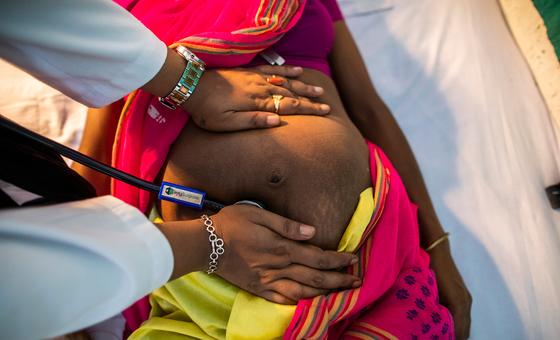
One pregnant woman or newborn dies every 7 seconds: new UN report

One pregnant woman or newborn dies every 7 seconds: new UN report

One pregnant woman or newborn dies every 7 seconds: new UN report
The report, Improving maternal and newborn health and survival and reducing stillbirth, assesses the latest data, which have similar risk factors and causes, and tracks the provision of critical health services.
Overall, the report shows that progress in improving survival has stagnated since 2015; with around 290,000 maternal deaths each year, 1.9 million stillbirths – babies who die after 28 weeks of pregnancy – and a staggering 2.3 million newborn deaths, during in the first month of life.
The report shows that over 4.5 million women and babies die every year during pregnancy, childbirth or the first weeks after birth, equivalent to one death happening every seven seconds, mostly from preventable or treatable causes if proper care was available. The new publication was launched at a major global conference in Cape Town, South Africa.
Health systems under stress The COVID-19 pandemic, rising poverty, and worsening humanitarian crises have intensified pressures on stretched health systems. Just one in 10 countries (of more than 100 surveyed) report having sufficient funds to implement their current plans.
According to the latest WHO survey on the pandemic’s impacts on essential health services, around 25 per cent of countries still report ongoing disruptions to vital pregnancy and postnatal care and services for sick children.
“Pregnant women and newborns continue to die at unacceptably high rates worldwide, and the COVID-19 pandemic has created further setbacks to providing them with the healthcare they need,” said Dr. Anshu Banerjee, Director of Maternal, Newborn, Child and Adolescent Health and Ageing at the World Health Organization (WHO).
“If we wish to see different results, we must do things differently. More and smarter investments in primary healthcare are needed now so that every woman and baby — no matter where they live — has the best chance of health and survival.”
Fighting for life Funding losses and underinvestment in primary healthcare can devastate survival prospects. For instance, while prematurity is now the leading cause of all under-five deaths globally, less than a third of countries report having sufficient newborn care units to treat small and sick babies.
In the worst-affected countries in Sub-Saharan Africa and Central and Southern Asia, the regions with the greatest burden of newborn and maternal deaths, fewer than 60 per cent of women receive even four, of WHO’s recommended eight, antenatal checks.
“The death of any woman or young girl during pregnancy or childbirth is a serious violation of their human rights,” said Dr Julitta Onabanjo, Director of the Technical Division at the United Nations Population Fund (UNFPA).
“It also reflects the urgent need to scale-up access to quality sexual and reproductive health services as part of universal health coverage and primary health care, especially in communities where maternal mortality rates have stagnated or even risen during recent years.
We must take a human rights and gender transformative approach to address maternal and newborn mortality, and it is vital that we stamp out the underlying factors which give rise to poor maternal health outcomes like socio-economic inequalities, discrimination, poverty, and injustice”.
Lifesaving care To increase survival rates, women and babies must have quality, affordable healthcare before, during and after childbirth, the agencies say, as well as access to family planning services.
More skilled and motivated health workers, especially midwives, are needed, alongside essential medicines and supplies, safe water, and reliable electricity. The report stresses that interventions should especially target the poorest women and those in vulnerable situations who are most likely to miss out on lifesaving care, including through better planning and investments.
Improving maternal and newborn health further requires addressing harmful gender norms, biases, and inequalities. Recent data show that only about 60 per cent of women aged 15-49 years make their own decisions regarding sexual and reproductive health and rights.
Based on current trends, more than 60 countries are not set to meet the maternal, newborn, and stillborn mortality reduction targets in the UN Sustainable Development Goals by 2030.
(The credit for all the inputs for this story goes to United Nations.)


Join Our Newsletter
Related News
Opinion
You May Also Like
Read More
Discussion
Readers' Comments
Recent
EDITOR PICKS
POPULAR POSTS
MUST READ

ABOUT US
Town Post is a leading News Portal of Jamshedpur and Jharkhand.
FOLLOW US
Contact us: editor@townpost.net
© Town Post, Jamshedpur