
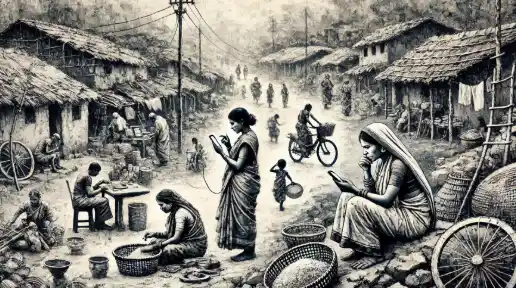
Jharkhand’s Maiyan Samman Yojna: A Game-Changer or a Short-Term Solution?

Jharkhand’s Maiyan Samman Yojna: A Game-Changer or a Short-Term Solution?
Maiyan Samman Yojna, offering direct financial aid to women, has sparked debates on its potential to transform Jharkhand’s rural economy.
Jharkhand’s Maiyan Samman Yojna delivers financial aid to women, but questions arise about its ability to create lasting socio-economic upliftment.

Jharkhand’s CM Hemant Soren launched the Maiyan Samman Yojna for all women aged 18-50 in August 2024. Under this scheme women are to receive an annual amount of 12000 rs. This was enhanced to 30,000 rs, post-elections which proved to be the deciding factor and the game-changer of the state elections in November 2024.
Jharkhand is not the only state giving women direct money to their individual accounts. Telangana was the first government to ever begin this kind of pension to the women of their state in 2017.
The list of pension schemes announced by different political parties of India are as follows:
JMM-Maiyya Samman Yojna
Congress-Pyari Didi Yojna
TMC-Lakhsmi Bhandar Yojna
AAP-Mahila Samman Yojna
BJP-Ladki Behan Yojna
Other states followed the norm and now these kinds of women pension schemes are running under different names.
Maharastra-Asmita Yojna
West Bengal-Lakshmir Bhandar
Karnataka-Gruha Lakshmi Scheme
Gujrat-Nari Niti Women’s Pride, Gender Equality
Goa-Griha Aadhar Scheme
Karnataka-Gruha Lakshmi Scheme
On January 6, due payment of the hiked amount was sent to the account numbers surpassing 56 lakhs.
The ambitions of the Maiyyan Samman Yojna of Jharkhand are as follows:
To end the vicious circle of debt from motive-driven money lenders.
To aid families to rise from severe conditions of penury
More contribution towards nutrition and education within families and thus reduced health expenses
To drive specially the remote areas financial cycle towards revitalization
However the ground reality about the absolute achievement of the ambitions are questionable. The money, while it has seen a recent increment won’t suffice a person’s sole expenditure in the present times. Let alone the sustenance of the entire family with needs of food, education, health. That being the case of the society on the whole. Jharkhand is an indigenous state and education has still not entered every threshold that on fruition can stimulate economic progress.
The weak road infrastructure which often brings forth the news of ‘woman giving birth to a child at home or a sick person being carried to the nearby health facility on a charpoy’,’ children’s struggle to reach school’, ‘farmers crossing the difficult terrains to reach the nearby marketplace’ due to lack of proper roads can’t be compensated by the monthly installments.
While the government presses on self-employment options, the unsharpened-skills of handicrafts etc. and lesser education are the giant obstacles for the women to fathom out the correct path for their own development.
Domestic labor has been since the beginning of civilization opinionated as too trivial to be given any kind of consideration but its due recognition absolutely depends upon the family members. Government has no or little role to play in these private scenarios.
Can a woman relying on an outer source for her living attain complete economic freedom with dignity? The question is refrained from discussion in the lieu of this present glamour of an easy path to attain financial aid without any contractual or permanent job.
It’s high time to fulfill the need for establishment of more educational and skill centers to make women self-reliant.
Erratically scattered cottage industries need to be brought under the unanimous umbrella of digital platforms to help the products garner markets from diverse and distant locations.
The sudden advent of money has certainly given momentum to the trailing economy of even the remotest areas but the scope of it to improve the living standard of women belonging to the necessitous families is still far from getting clear.


Join Our Newsletter
Opinion
You May Also Like
Read More
Discussion
Readers' Comments
Recent
EDITOR PICKS
POPULAR POSTS
MUST READ

ABOUT US
Town Post is a leading News Portal of Jamshedpur and Jharkhand.
FOLLOW US
Contact us: editor@townpost.net
© Town Post, Jamshedpur