
Household Consumption Expenditure Rises with Rural-Urban Gap Narrowing

Household Consumption Expenditure Rises with Rural-Urban Gap Narrowing

Rural households report significant growth in consumption as urban areas maintain lead
Key Points:
- Rural MPCE averages Rs. 4,122; urban Rs. 6,996 in 2023-24.
- Urban-rural gap in MPCE narrows from 84% (2011-12) to 70% (2023-24).
- Consumption inequality decreases, Gini coefficient declines for both areas.
JAMSHEDPUR – The Ministry of Statistics and Programme Implementation has released findings from the 2023-24 Household Consumption Expenditure Survey, showing a rise in average consumption across India, with a narrowing gap between rural and urban areas.
The survey covers data from over 2.6 lakh households, highlighting increased expenditure trends and reduced inequality.
National Trends Reflect Growing Economic Balance
The report reveals that rural households’ average Monthly Per Capita Consumption Expenditure (MPCE) stands at Rs. 4,122, while urban households average Rs. 6,996 without considering social welfare benefits. Including these benefits, the figures rise to Rs. 4,247 and Rs. 7,078, respectively. Notably, the rural-urban MPCE gap has decreased to 70% in 2023-24, reflecting stronger growth in rural consumption.
A Ministry official remarked, “The narrowing urban-rural gap underscores the impact of welfare programs and rising rural economic activity.”
Consumption Inequality and Sectoral Expenditures
Consumption inequality has also seen a decline, with Gini coefficients dropping from 0.266 to 0.237 in rural areas and from 0.314 to 0.284 in urban areas. Non-food expenditures remain dominant, accounting for 53% in rural areas and 60% in urban areas, with notable spending on conveyance, durable goods, and entertainment.
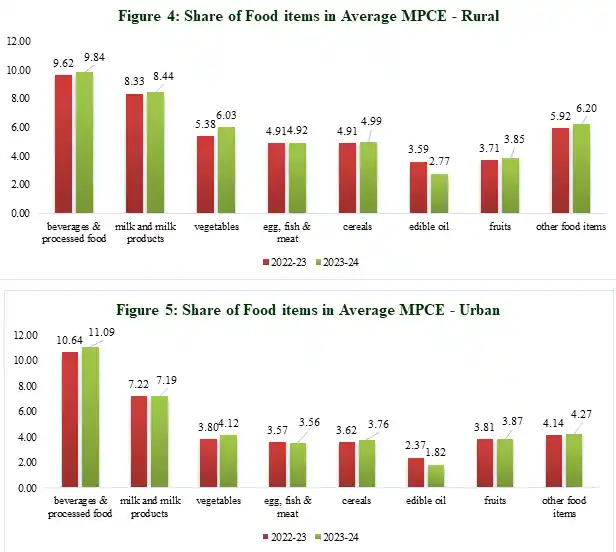
Food expenses are led by processed items and beverages, showing consistent patterns from the previous year.
Regional Variations Highlight Disparities
Sikkim tops the charts with the highest MPCE, while Chhattisgarh records the lowest. Rural areas in Sikkim average Rs. 9,377 and urban areas Rs. 13,927. In contrast, Chhattisgarh reports Rs. 2,739 and Rs. 4,927, respectively. The largest rural-urban disparities are seen in Meghalaya, Jharkhand, and Chhattisgarh.
The bottom 5% of rural households show a 22% increase in MPCE, while the same segment in urban areas registers a 19% growth, indicating improvements in economic well-being for lower-income groups.
Looking Ahead
The data will help policymakers refine welfare schemes and update consumer price indices. It also provides a comprehensive picture of economic well-being and spending patterns across demographic and regional divides.


Join Our Newsletter
Related News
Opinion
Read More
Discussion
Readers' Comments
Recent
EDITOR PICKS
POPULAR POSTS
MUST READ

ABOUT US
Town Post is a leading News Portal of Jamshedpur and Jharkhand.
FOLLOW US
Contact us: editor@townpost.net
© Town Post, Jamshedpur