
Jharkhand Scraps Controversial Mandi Tax Plan After Protests

Jharkhand Scraps Controversial Mandi Tax Plan After Protests

Government pledges support for farmers and traders after key meeting
Jharkhand officials abandon APMC Mandi Tax proposal following strong opposition from trade and farming groups.
RANCHI – Officials backtrack on controversial Mandi Tax plan after intense discussions with trade and farmer representatives.
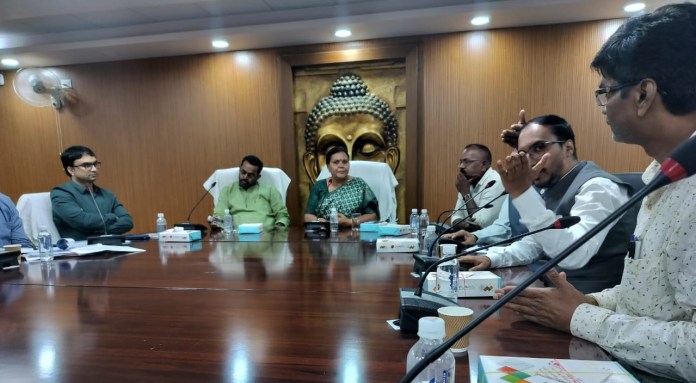
The Jharkhand government’s proposal to impose a Mandi Tax on the Agricultural Produce Market Committee (APMC) has been met with significant resistance, prompting a crucial meeting at the Agriculture Directorate in Ranchi.
Representatives from various trade organizations and farming communities gathered to voice their concerns about the potential impact of the tax.
The Singhbhum Chamber of Commerce and Industry has been at the forefront of the movement against the proposed tax.
Key figures from the organization, including Vice President Anil Modi, Vyapar Mandal President Deepak Bhalotia, and Vice President Pawan Naredi, presented a united front at the meeting.
Anil Modi emphasized the serious threat the Mandi Tax posed to traders’ livelihoods.
He outlined several demands aimed at improving market conditions and infrastructure instead of implementing the tax.
"Our primary concern is the survival of our trading community," Modi stated.
"We believe there are better alternatives to support both farmers and traders without resorting to additional taxation."
Proposed Alternatives to Mandi Tax
Among the proposals put forward by Modi was the formation of a society comprising experienced traders to oversee market committee operations.
This group would be responsible for maintenance and development initiatives within the committee.
Another suggestion involved the conversion of existing market committee shops into two-storey structures.
These renovated buildings would serve as offices and warehouses, with traders funding the construction.
Modi also advocated for leasing shops to seasoned traders, a practice he noted was common in other states.
A key point of discussion was the development of the Parsudih market committee.
Modi urged that it be transformed into a major, attractive marketplace rather than a collection of warehouses.
"We envision a vibrant commercial hub that will benefit both traders and farmers," he explained.
Infrastructure Improvement Plans
Infrastructure improvements were high on the agenda, with calls for better sanitation facilities, road repairs, and the installation of CCTV cameras for enhanced security.
Modi also stressed the need for a cold storage facility to preserve perishable goods, highlighting its importance for modern market operations.
In response to these concerns and proposals, the minister assured attendees that the government had no immediate plans to impose the Mandi Tax.
Instead, he pledged support for both farmers and traders through alternative measures.
"Our goal is to create an environment where all stakeholders in the agricultural sector can thrive," the minister stated.
He committed to personally visiting market committees to gain firsthand insight into the challenges faced by traders and farmers.
This development marks a significant victory for the Singhbhum Chamber of Commerce and Industry and its allies.
Their collective action has demonstrated the power of organized protest in shaping government policy.
As Jharkhand moves forward, the focus now shifts to implementing the proposed improvements and ensuring that the needs of both farmers and traders are adequately addressed.
The coming months will be crucial in determining how effectively these plans are translated into action, potentially setting a new standard for agricultural market management in the state.


Join Our Newsletter
Opinion
Read More
Discussion
Readers' Comments
Recent
EDITOR PICKS
POPULAR POSTS
MUST READ

ABOUT US
Town Post is a leading News Portal of Jamshedpur and Jharkhand.
FOLLOW US
Contact us: editor@townpost.net
© Town Post, Jamshedpur