
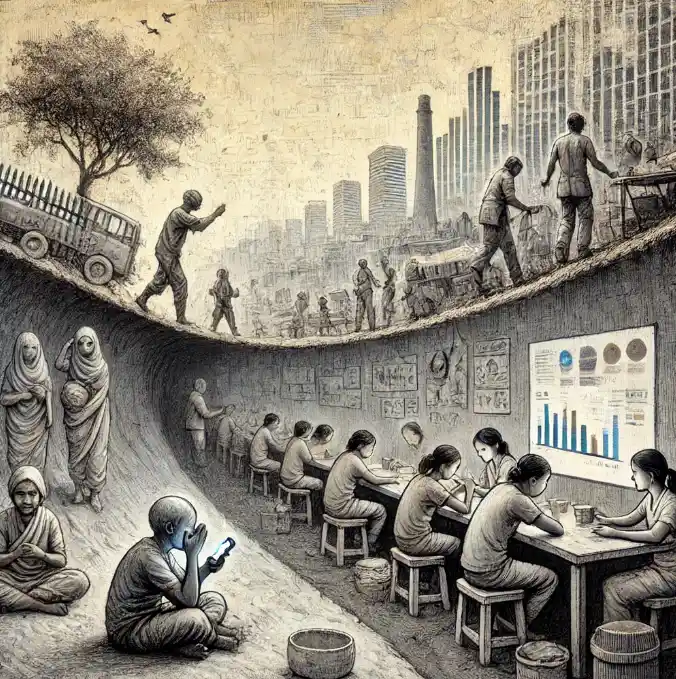
Evaluation of Mental Health Crisis: A Crying Need

Evaluation of Mental Health Crisis: A Crying Need
India’s 126th rank in the World Happiness Index 2024 underscores a pressing mental health crisis, reflecting societal and emotional challenges.
India’s low position in the 2024 World Happiness Index points to a significant mental health crisis, evident in incidents like the Uttarakhand tunnel entrapment and reverse migration in Sweden. In today’s fast-paced world, mental resilience is crucial for all age groups. Strategies such as mindfulness, reconnecting with hobbies, and community engagement are essential to combat psychological challenges and foster emotional well-being.

The release of World Happiness Index 2024 on 20th March ranked India on the 126th spot out of 143 countries of the world. This signifies the lower happiness ratios among people which is another reflection of mental health status.
Mental health is no longer an alien term for anyone whatsoever. Still the taboo associated with it is not much cordially accepted by the society. Mental health is directly proportional to life’s situations and complexities and neglecting if for a long time might yield severe results.
The true need and importance of mental health can be understood by the Uttarakhand tunnel entrapment November 2023 incident.
The time spent to rescue the laborers took more than anticipated and both their physical and emotional fitness became the cause of concern for everyone.
Alternative narrow channels were used to provide them food, medicines. Arrangements were made for their counseling and mobiles were provided for them to stay connected with their families. The inclusion of these efforts were to prohibit them from becoming despondent.
Reverse migration wave as seen among Indians living in Sweden may have several factors but the one that tops the charts is the loneliness and lack of cultural compatibility. This is ramification of psychological health.
There is constant research going on in every part of the world emphasizing on betterment of mental health in modern times. Now the thing is how to maintain our own mental resilience. In the highly fast-paced and competitive era it has become more vulnerable than before. No age-group is beyond the clutches of it as of now.
It has not stayed binded among adults, working and retired people but the mental equilibrium is found to be an erratic issue among the minors racing down to toddlers.
The children of working parents, the lessening of community development programs, overuse of technology, the reduction of tolerance levels has led to practice of isolated individualism.
Although there are several ways to combat mental imbalance and re-begin to feel positive about life. It begins with mindfulness exercises like yoga or walks. Focusing on the positive part of happenings and reframing from negative thoughts like fear and uncertainty about the future.
In studies conducted upon one lakh Japanese people between ages 10 and 69, video games when played in moderation help in enhancing the joyous genes levels of a person.
Spending time among nature and understanding the mechanism of embracing every season with grace give way to hopefulness.
Also joining the social groups with like interests help win over the unhealthy state of mind. Returning back to childhood hobbies shelved among the busy lives and skill development give a reason to stay occupied and ward off depression.
Even after all these efforts, bringing lifestyle changes nothing seems to work out, showing the sufferer the light at the end of tunnel, still there is possibility.
There are several NGOs and mental health centers who have volunteers, experts, helplines to help people who are undergoing difficulties in synchronization with constructive and indisputable cognitive well-being.
All that is needed is timely diagnosis and support of family and society to achieve the said.


Join Our Newsletter
Related News
Opinion
You May Also Like
Read More
Discussion
Readers' Comments
Recent
EDITOR PICKS
POPULAR POSTS
MUST READ

ABOUT US
Town Post is a leading News Portal of Jamshedpur and Jharkhand.
FOLLOW US
Contact us: editor@townpost.net
© Town Post, Jamshedpur