
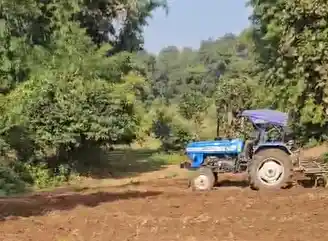
Rapid Destruction of Illicit Opium Fields in Jharkhand: A Controlled Operation

Rapid Destruction of Illicit Opium Fields in Jharkhand: A Controlled Operation
The Administration’s Swift Action in Jharkhand Highlights India’s Tight Regulation of Opium Cultivation Amid Rising Abuse.
India’s opium production is limited to Rajasthan, Madhya Pradesh, and Uttar Pradesh. Strict government oversight ensures safe cultivation for medicinal use.

The wreckage of illicit opium cultivation in Jharkhand is done at a fast-rate by the administration. The only states of India possessing the license of opium cultivation and production are Madhya Pradesh, Uttar Pradesh and Rajasthan.
HISTORY OF OPIUM CULTIVATION IN INDIA
Opium cultivation dates back to the 15th century in Khambhat and Malar regions of ancient India.
During the Mughal Empire, opium cultivation outstretched to larger areas and entered into trade deals with China and other eastern countries. State monopoly was imposed on opium trade in the second half of the 16th century. Near the end-phase of the Mughal empire, the group of Patna merchants began to dominate the trade. In 1757, the ownership slipped into the hands of the East India Company, which had by then occupied the revenue collection rights in Bihar and Bengal.
In 1873, the contemporaneous Governor General Lord Hastings made the opium trade, a government controlled occupation. This ban prohibited the open farming of opium. Thus, from then began the regulated procedure of opium cultivation and production under government monitoring.
HIGH DEMAND OF POPPY
In spite of high demand of poppy seeds in the food industry and opium for the pharmaceutical industry, why does the Indian government stick to the already established domains, depending on imports from countries like Afghanistan. The process of poppy cultivation has the answer to this as the byproduct of this cultivation is a highly addictive substance called morphine. Hence every safety measure is taken for the entire process of production and sales.
PROCESS OF OPIUM CULTIVATION
It is a Rabi crop and is sowed in the month of November. The harvest gets ready by March-April. The farming of opium in a single hectare needs 7-8 kilos of poppy seeds. Separate attention is mandatory to be given to each plant. The pods coming out of the plants are incised for the morphine to roll down. This morphine is handed over to the narcotic department. The farmers have to fulfill the obligation to fence fields which comes pricey. Under the factors of non-fencing, crop infections, a poppy plant’s disappearance the farmer is seeked for clarification. It leads to cancellation of the license earning and maintaining which is a hard cut to crack.
After the pods mature, and the poppy seeds are removed the crushed pods called poppy straw again have to be submitted to the narcotic department, because they contain a sparse amount of morphine residues. The entire production is supervised by the narcotics departments. Further the state government handles the sale of the poppy straws for medical and scientific purposes.
WHY DOES INDIAN GOVERNMENT MAKE NO AMENDMENTS BY EXPANDING THE AREAS OF CULTIVATION
India is one among the twelve countries to secure the rights for opium farming and post-farming activities. The United Nations’ Single Convention on Narcotic Drugs-1961 is an international treaty that controls the manufacturing activities i.e. cultivation, production, supply, trade, transport of few specific narcotic drugs. It lays down a system of regulations for their medicinal and scientific use where they aren’t presumed to have negative connotations. It was amended in 1972 which received in 2022 the ratification by 186 countries.
Because of the high-demand of opium in the market of substance abuse, several precautionary measures are simply the tools to combat the misuse of this essential drug.
The recent and urgent operation of destruction of the opium fields in Jharkhand is an extended attempt to control the increasing intoxication percentage in the society.


Join Our Newsletter
Related News
Opinion
Read More
Discussion
Readers' Comments
Recent
EDITOR PICKS
POPULAR POSTS
MUST READ

ABOUT US
Town Post is a leading News Portal of Jamshedpur and Jharkhand.
FOLLOW US
Contact us: editor@townpost.net
© Town Post, Jamshedpur