
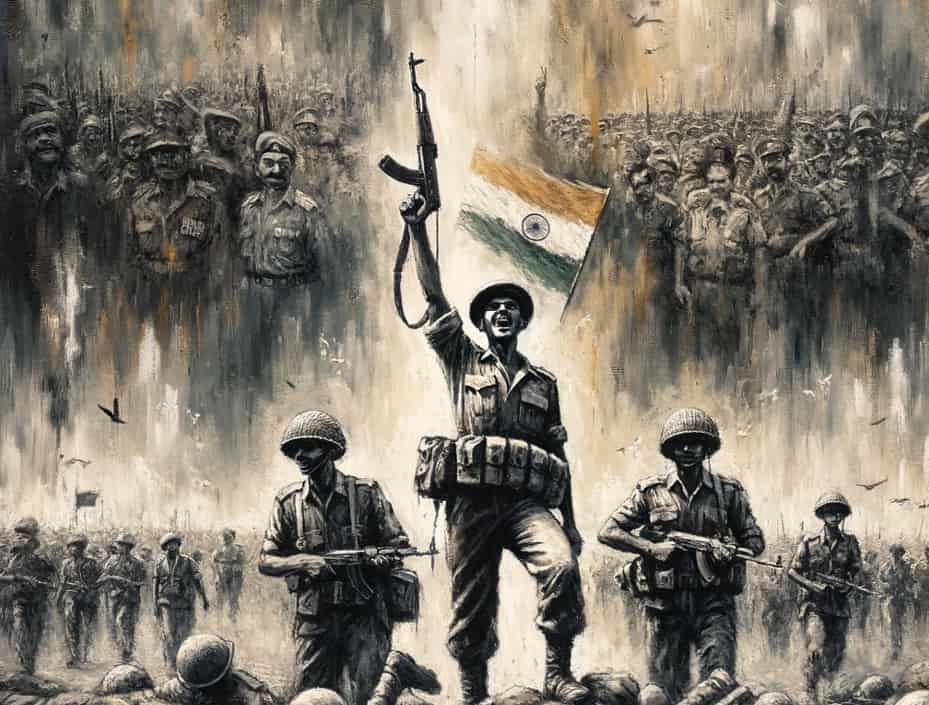
India's Vijay Diwas: A Defining Moment in National History

Vijay Diwas Marks India’s Triumph Over Unprecedented Adversity

Vijay Diwas commemorates a pivotal moment in India’s history, celebrating the Indian Armed Forces’ remarkable victory over Pakistan in 1971.
This victory, achieved through unyielding determination, is more than a military triumph; it is a testament to India’s resilience against overwhelming odds.
The Nixon-Kissinger duo’s blatant disregard for Pakistan Army’s atrocities, particularly against Hindus in West Pakistan, underscored a global power dynamic dismissive of third-world nations.
As Gary J Bass rightly says in his book The Blood Telegram – ““Understanding clearly that what they were doing was illegal, Nixon and Kissinger did it anyway.”
This war, transcending mere territorial disputes, was a battle for India’s identity, emerging from centuries of subjugation under Islamic and Christian powers.
It was a struggle against a dangerous alliance of Islamic extremism and superpower arrogance. India’s success in this conflict, despite the Nixon administration’s support for Yahya Khan’s regime, was not just a military feat; it marked India’s emergence as a formidable global presence.
This victory symbolizes India’s enduring spirit and its refusal to be marginalized, solidifying its rightful place on the world stage.
Vijay Diwas is a reminder of the indomitable will of a nation that stands resolute in the face of adversity.
Whatever her flipside, late Indira Gandhi, the then PM of India did lead the country well in that war. She was pitted against worst enemies on all sides. Yet she led well showing an iron will.
Gary J Bass’s words show what she had to contend with during that entire period. Gary wrote: “While Pakistan plunged into civil war, Kissinger looked for massacres committed by Bengalis, to generate a moral equivalence that would exonerate Yahya. It would be convenient for Nixon and Kissinger to be able to say that both sides were equally rotten.”
That India emerged victorious in that war is the reason we are alive and kicking today.


EDITOR PICKS
POPULAR POSTS
MUST READ

ABOUT US
Town Post is a leading News Portal of Jamshedpur and Jharkhand.
FOLLOW US
Contact us: editor@townpost.net
© Town Post, Jamshedpur