
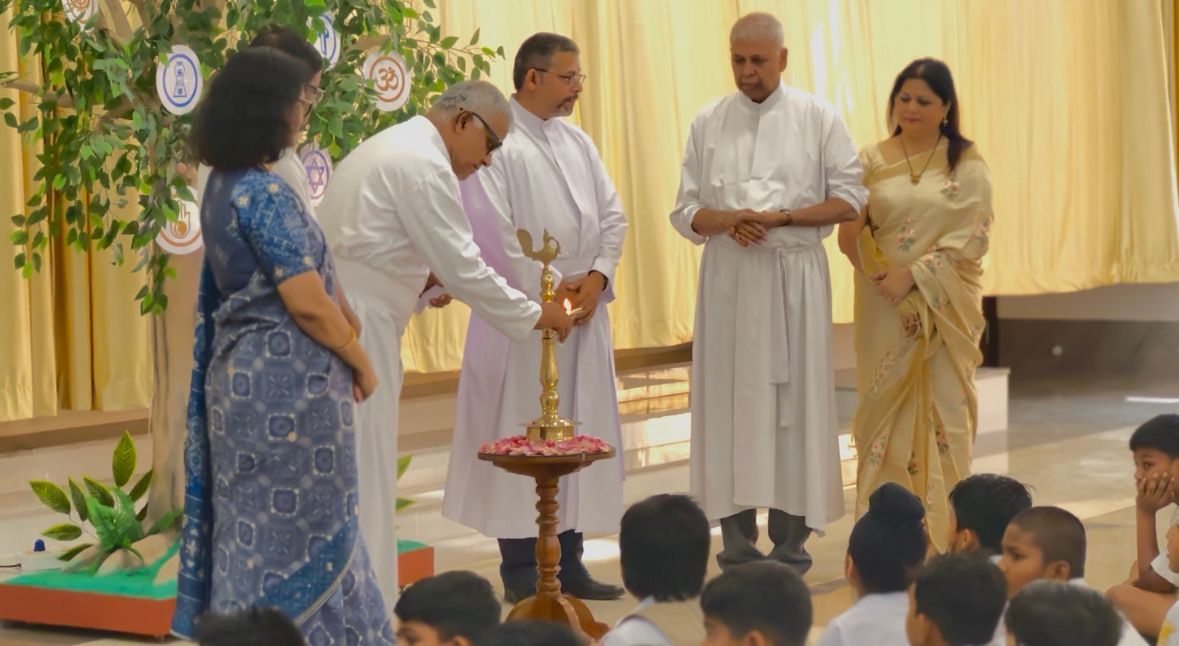
Why a Multi-Faith Prayer Hall in a School is a Bad Idea!

There is a Growing Need for Secular Education and Faith-Free Learning Environment Instead of Multi-Faith Cuisine of Unreason And Voodoo

Inauguration of a multi-faith prayer hall in Loyola School is a bad idea.
It is sad that it is said to have been ideated by a genuinely excellent educationist, Fr Pius Fernandes, who knows it all, and has perhaps experienced it all too.
The primary purpose of schools is to provide a strong foundation in education, encouraging critical thinking and fostering intellectual growth.
As such, the concept of prayer halls in schools seems incongruous with this mission.
Parents send their children to schools for education, not for religious instruction or practice.
While Father Pius may have had good intentions in proposing a multi-faith prayer hall, it is important to remember that good intentions do not always lead to positive outcomes.
And as most devout people know- even the road to hell is paved with good intentions.
Historically, when religious beliefs have held commanding positions, the world has often witnessed increased violence, exploitation, ignorance, and indescribable cruelty.
In moving away from faith-based practices in education, we can create a more peaceful and unified learning environment.
Comparing Afghanistan and Japan, it becomes evident that a country with a stronger focus on secular education tends to be more habitable and harmonious.
Schools should prioritize secular education without the influence of faith or prayers.
Families and homes can serve as the appropriate environments for religious instruction and practice, allowing schools to focus on their primary purpose – education.
It is essential to recognize that the concept of a prayer hall, or reading lines from a holy book en masse, is an Abrahamic notion and may not hold the same meaning, or importance, for other faiths, such as Hinduism.
Hindu boys and girls would rather prefer to sing, dance and whistle keeping their deities in their laps instead of seeking pardon for being unfortunate enough to be born as perpetual sinners.
For many, especially Hindus, it would be akin to a Henry Ford saying – you may choose a car of any colour as long as it is black.
Because Hindus do not merely pray, they also live with and live in their deities.
Multifaith spaces that do not accommodate the diverse beliefs and practices of the individuals ultimately fall short of their intended inclusivity.
Unless what is intended is something else than ‘inclusivity’.
For example, a multi-faith prayer hall that does not include idols of a deity for Hindu students is not truly representative of their beliefs.
They will need idols to pray.
And it would take some leap of faith, even for someone ostensibly as accommodative of other faiths as Father Pius, to allow placing of idols of Hindu deities in such multi-faith prayer halls. .
Also, for many students from Abrahamic faiths, it would be sacrilegious to even think on the lines of ‘Aham Brahmasmi’ or I am the creator, which is purely a Hindu concept and completely untranslatable, and also indigestible for many others.
Instead of expending resources on creating prayer halls, schools should focus on imparting real education, science, and social sciences.
Why create multicornered confusion porridge for everyone for no reason?
A multifaith prayer hall in a school is a misguided idea if its primary goal is to provide a well-rounded education.
Schools should concentrate on creating an inclusive, secular learning environment that encourages intellectual growth and critical thinking, leaving religious instruction to families and communities.
After all, parents send children to schools to help them develop critical thinking like Richard Dawkins. And real science has shown it quite clearly that Prayers only hinder and do not facilitate this process.


EDITOR PICKS
POPULAR POSTS
MUST READ

ABOUT US
Town Post is a leading News Portal of Jamshedpur and Jharkhand.
FOLLOW US
Contact us: editor@townpost.net
© Town Post, Jamshedpur